Home » How the Rocky Mountains Formed: A Journey Through Changing Scientific Ideas

How the Rocky Mountains Formed: A Journey Through Changing Scientific Ideas

“Science is finding out where we’re wrong.” -J. Robert Oppenheimer

I often hear people ask, “Why are scientists always changing their minds?” I think this is a misunderstanding of science. Science is built to change as new information becomes available. Let me give you an example from geology. The basic question that we will look at is the formation of the Rocky Mountains.

Cooling Earth Hypothesis – Late 1800’s

A student of geology in the early 1900s might have been introduced to the cooling earth hypothesis: as the hot interior of the earth cooled and contracted, geologists believed the rigid outer crust was forced to wrinkle and fold to fit the smaller circumference, much like the skin of a drying apple. These wrinkles were thought to form mountain ranges. It is a fact that the interior of the earth is cooling, so this was not a totally unreasonable idea. This is where the problem of incomplete information, and dare I say disinformation, comes from. A kernel of truth is expanded far beyond its relevance. The earth’s core is cooling at a rate of about 55 degrees Celsius per billion years. The temperature at the core ranges from about 6000–4000 degrees Celsius. This cooling on the order of billions of years makes any surficial effects negligible.

decaying apple

Continental Drift -1915

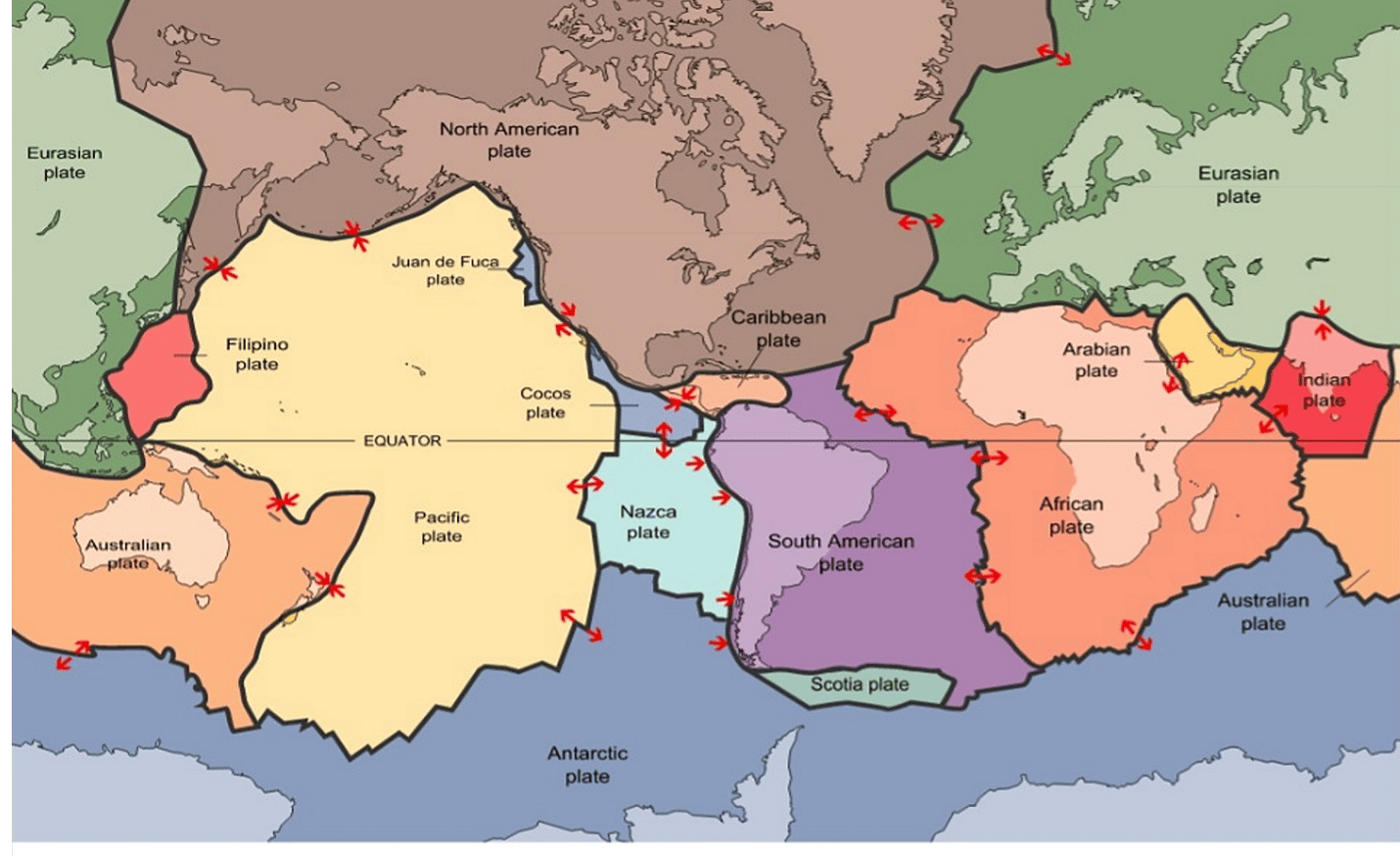
In the early 1900s, a plate tectonic hypothesis was proposed by German meteorologist Alfred Wegener. Wegener presented his ideas in The Origin of Continents and Oceans, published in 1915. Most geologists at the time rejected his theory because back then, there was no mechanism understood to cause such “continental drift.” Wegner proposed tidal forces, as well as other relatively weak forces which did not account for the immense energy needed to move continents. During World War II, mapping of the seafloor for military purposes revealed multiple oceanic ridges; in the 1960s the idea of seafloor spreading was confirmed by magnetic measurements on either side of the spreading ocean ridges. By the late 1960s, a synthesis of continental drift and seafloor spreading led to the modern theory of plate tectonics.

Tectonic Plates of the Earth

Poor Wegner didn’t live to see some of his ideas substantiated by data. There is a natural conservatism to science. Wegner being a meteorologist, and not a geologist, may have slowed the acceptance of his ideas. However, even those most reticent to change are forced to it by the weight of evidence. By the late 1970s, plate tectonics had revolutionized geology. The push and convective pull of plates explained crustal motion. Subduction of oceanic plates and collision of continental plates explained mountain building in many parts of the world.

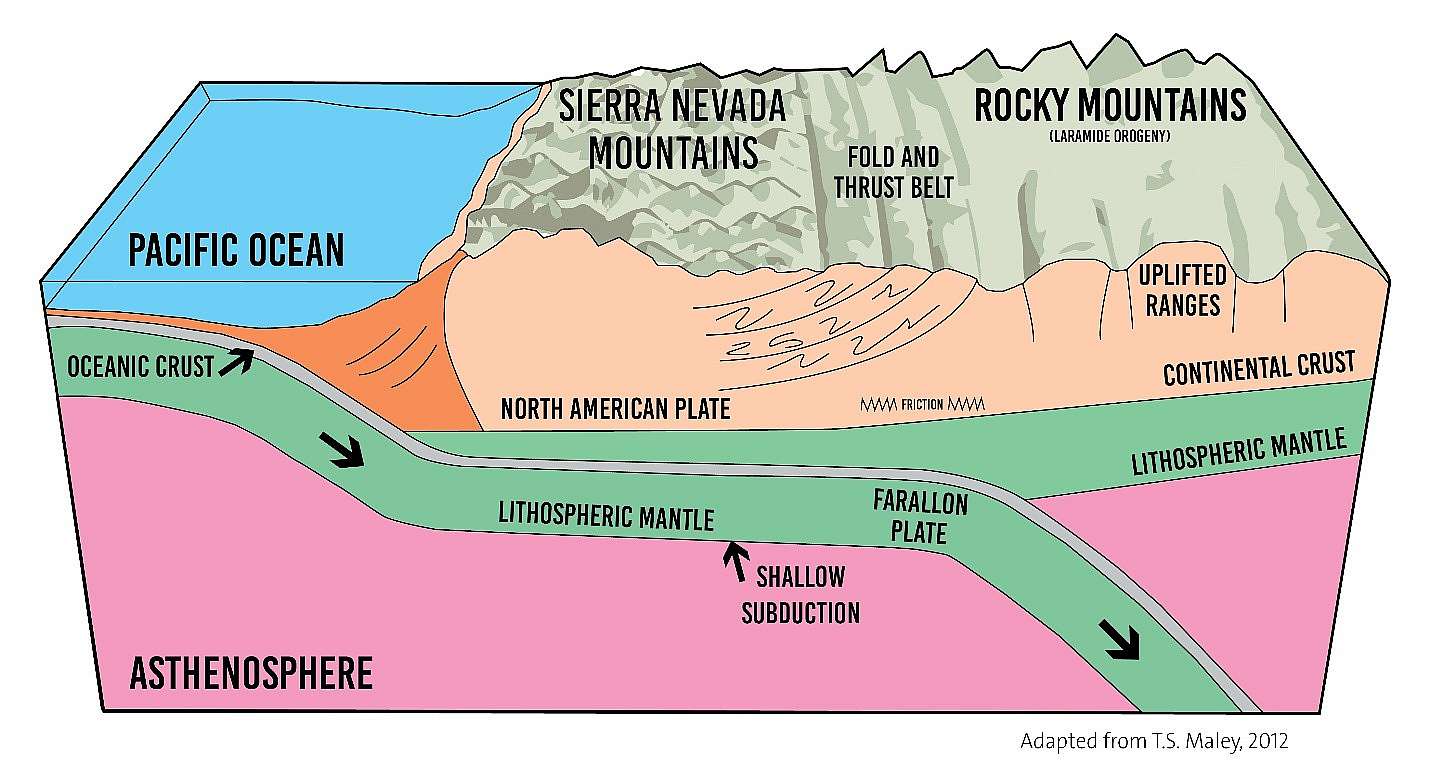
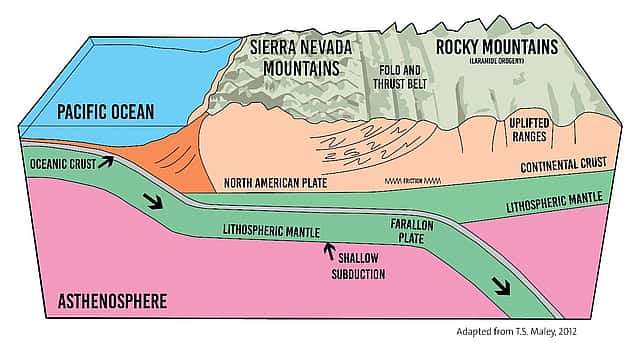
An analog from the Andes of South America was proposed by Dickenson et al. (1978) for the Laramide Orogeny (mountain building of the Rockies in the western United States). This analogy is called flat slab subduction: the supposition that the ancient Farallon plate slid under the North American Plate at a shallow angle uplifting mountain ranges.

There have been many revisions to the flat slab idea in the intervening years. New technologies have been able to peer ever deeper into the earth such as Computerized Tomography. We have all heard of MRI and CT scans in a medical context; the same technology is used with earthquake waves providing the energy source to resolve imaging. Tomographic images beneath the western United States have enabled reconstruction of ancient, subducted plates, bolstering for some, the flat slab explanation for mountain building in the Laramide Orogeny.

Hit and Run 1960s

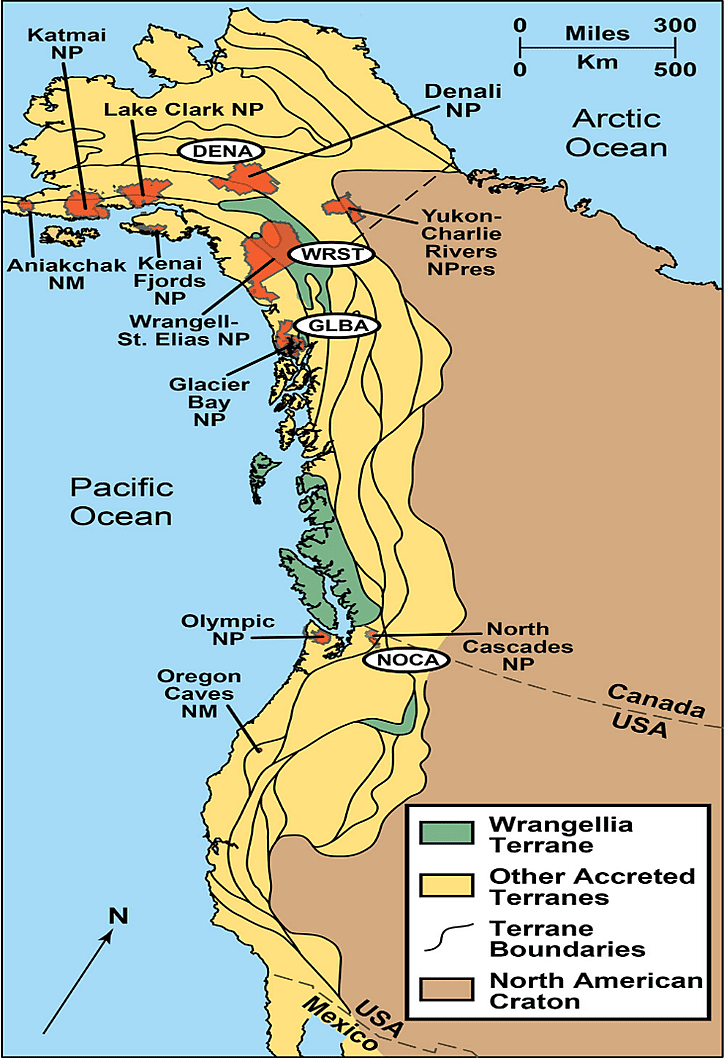
The mid 1960’s marks a period when geologists actively studying tectonic movements, and ideas of how plates interact at angles, bolstered by paleo magnetic data, developed a theory colloquially called “Hit and Run”. Tickoff et al. in 2022 further elucidated the “Hit and Run” model adding tomographic data. The western most part of north America is accreted terrane—everything west of a line roughly following the western border of Idaho is younger material that was added on to the continent. This material can be thought of as large island arcs slamming into the North American Craton, which is the original continental material.

The image illustrates positions of accreted terranes today. Image credit NPS

The “hit” in this model is the superterranes hitting the craton causing compression and the “run” is the superterranes translating north to their present positions forming the western coasts of Mexico, the United States, Canada, and Alaska. The “Hit and Run” model is gaining some traction in geological circles. As with most fundamental science, data gathering processes improve and conclusions change.

Thank you for taking this walk with me through one small aspect of geology in a small slice of the earth. I am always in awe when I think about all the specialized fields of science and how far we have come. It is also awe-inspiring to think about how far we have yet to go.

Written By

George Miller avatar

George Miller

George Miller is the Education Web Content Creator/Outreach Educator at the Buffalo Bill center of the West. George also facilitates Skype in the Classroom, teaching students nationally and internationally. George is a member of the American Association of Museums and holds a B.S. in Anthropology from the University of Utah and a M.Ed. in Adult Education from Oregon State University. Outside work, George teaches skiing at Red Lodge Mountain, enjoys whitewater rafting, painting, playing music and practicing yoga.

You May Also Like