Home » The Cowboy Painter from Hoboken
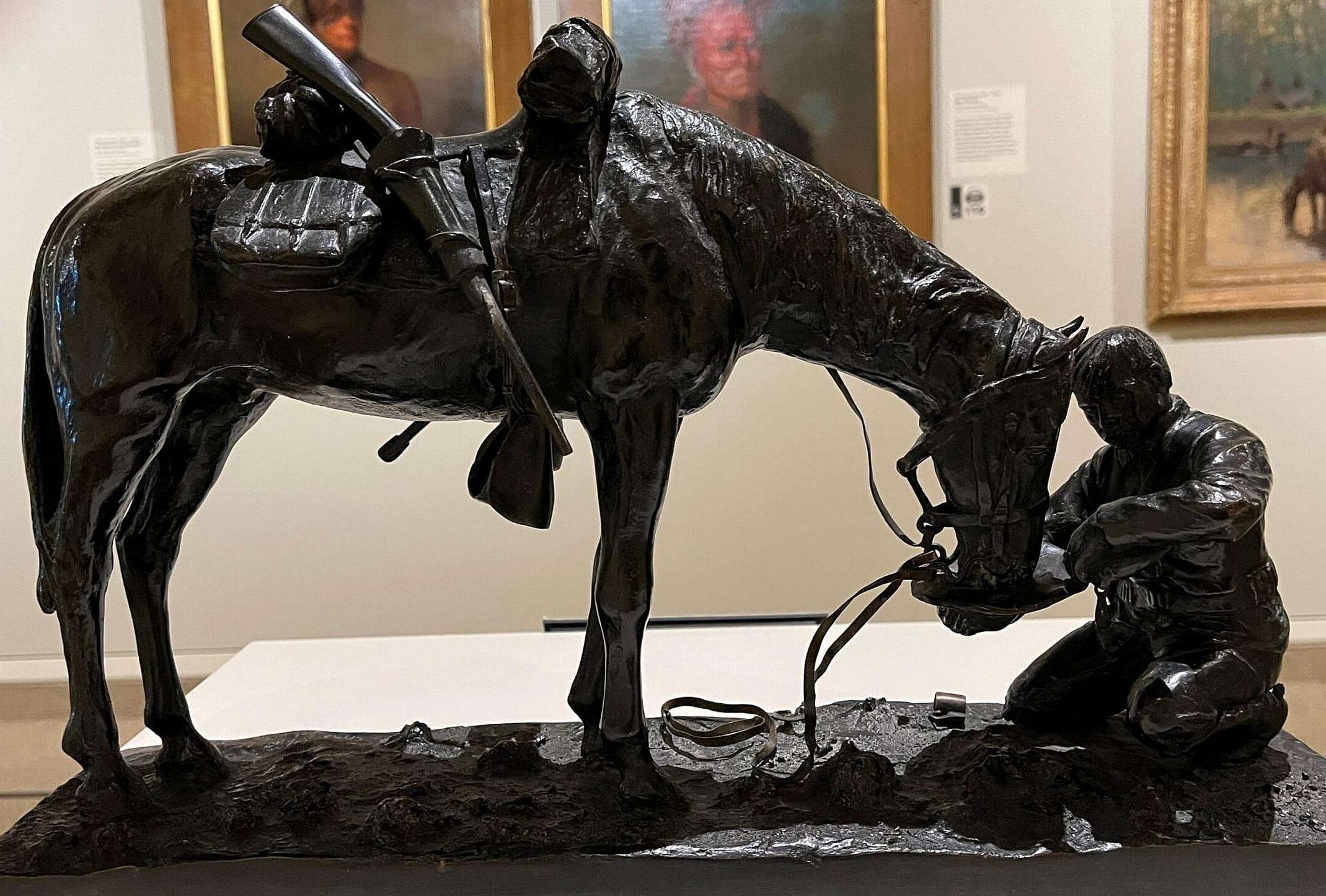
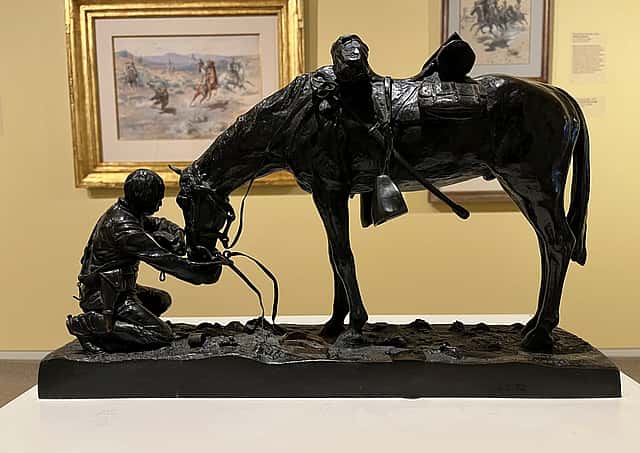
Copyright 1903, bronze cast edition #72. Roman Bronze Works, NY. Gift of Mr. and Mrs. Ernest J. Goppert, Sr. 55.72

The Cowboy Painter from Hoboken

A Western Artist Born Far from the West

Few would expect one of the most talented and knowledgeable western artists to hail from the East Coast, namely Hoboken, New Jersey, and that’s the paradox of Charles Schreyvogel’s career as an artist. Surely the distance between Hoboken and the American frontier would prove difficult for any artist to pursue and paint Western scenes, and yet Schreyvogel’s artistic success rivaled that of the great Fredric Remington despite his reputation as a “city boy.” Schreyvogel’s research-driven method as part of his creative process provided keen insight into the success of his artwork and demonstrates how, from the rooftop of his Hoboken home, his imagination helped humanize the West for millions of Americans.

City Born with Western Ambitions

Born in 1861 during the early years of the Civil War as the son of a German immigrant, Schreyvogel enjoyed an idyllic early life on Manhattan’s Lower East Side until the gangs of New York encroached upon the neighborhood’s middle-class peace; so, his father moved the family to Hoboken, New Jersey for a quieter existence. His Hoboken upbringing stood in stark contrast with the gritty harshness of frontier life he would later capture on canvas (and sculpture). In the late 1800s, Schreyvogel gained inspiration from the famous explorer-artists like Thomas Moran and George Caitlin, and western novels and early western films helped him to discover the adventure and excitement of the frontier. Unlike Moran and Caitlin, Schreyvogel fed his artistic muse intellectually, not experientially. Because of this, two things became inevitable for Schreyvogel: the need for cultural accuracy in his artwork, and the criticism of those who decried his urban upbringing given his western subject matter. He longed to visit the West in person.

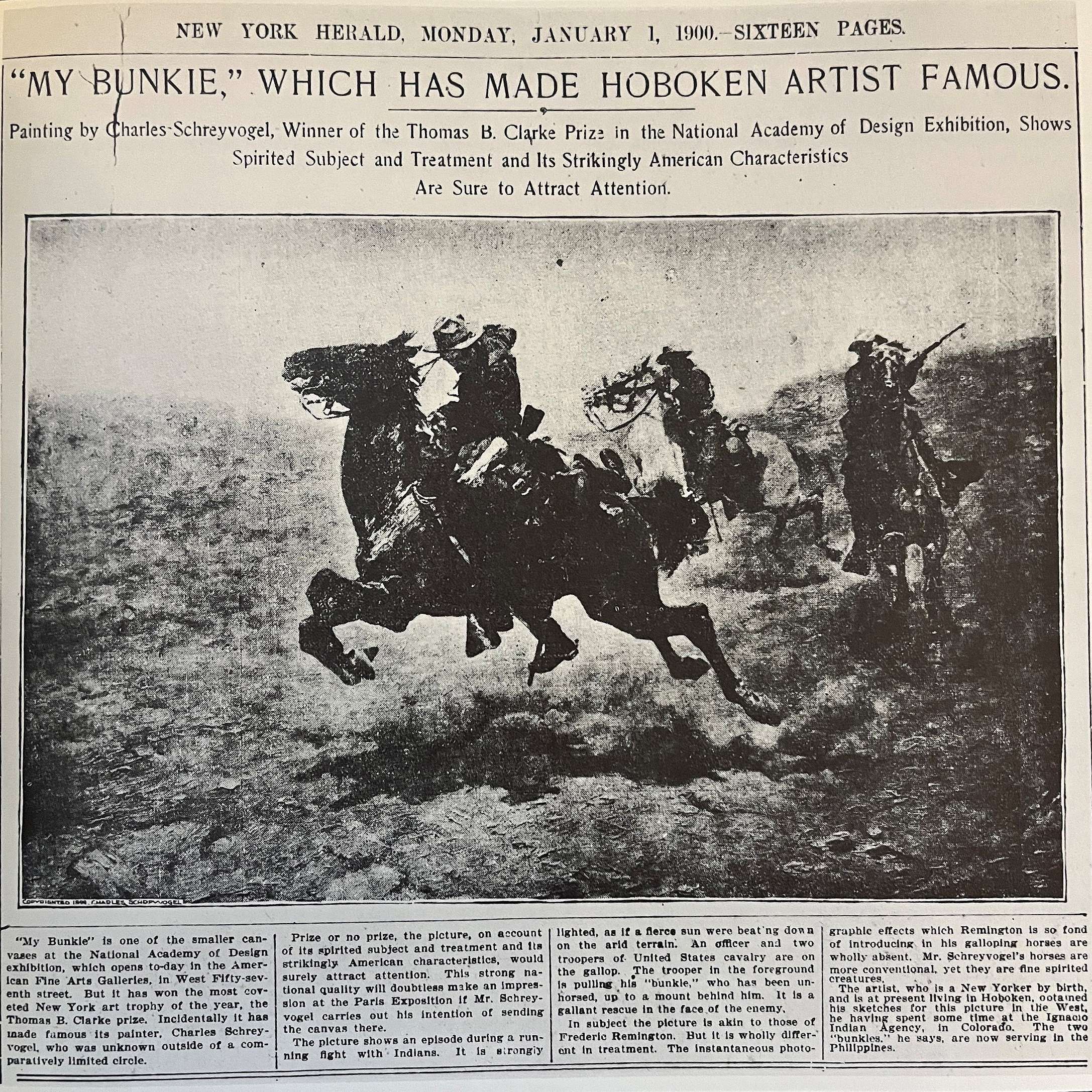
New York Herald Headline. January 1, 1900. New York Historical Society, New York City.
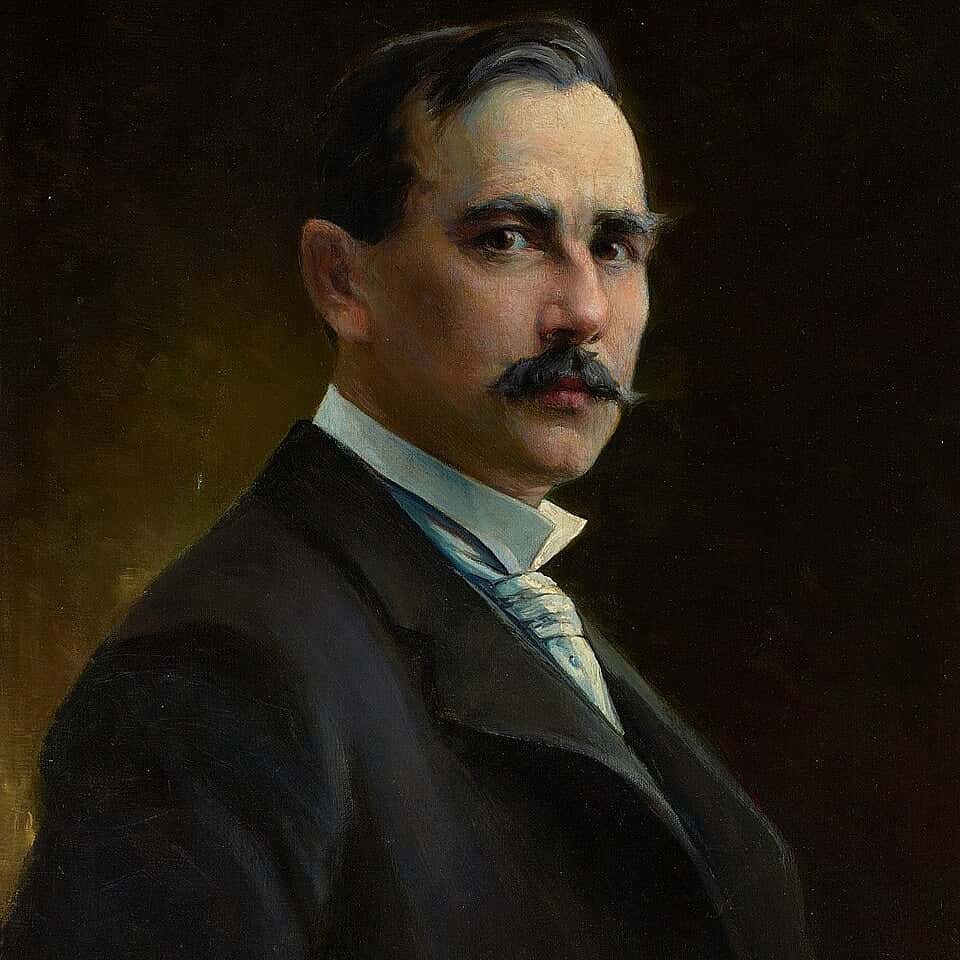
Charles Schreyvogel
Portrait of Charles Schreyvogel by Henry August Schwabe (1843-1916). Public domain.

A Pining for the West

Despite his meticulous detail and historical accuracy gained through research, Schreyvogel pined to visit the West to gain first-hand knowledge of cowboys, Indians, the Plains, the mountains, and the cowboy life. Not only would this improve upon his artwork, but it would also silence his detractors who claimed that a kid from Hoboken couldn’t possibly express the West accurately. Author James Horan, in his book The Life and Art of Charles Schreyvogel, notes that Schreyvogel pursued his subject matter wherever he could, including sketching “the veterans of the Indian campaigns who had been transferred to New York’s Governor’s Island, where they rode in tournament and miliary pageants,” adding that “he never neglected the smallest of these means for making himself familiar with the West.” 

Buffalo Bill Lends a Hand

Buffalo Bill played a crucial role in Schreyvogel’s artistic development and became an enthusiastic supporter of his work. As noted by James Horan, when Cody’s Wild West Show visited New York City, “Schreyvogel spent most of his days and nights on the lot sketching cowboys, Indians, and horses. It was the beginning of a friendship that would last many years.” Soon Schreyvogel and his wife Louise befriended the performers and even rode in Buffalo Bill’s famous Deadwood Stagecoach. This key relationship with Cody fueled Schreyvogel’s western muse until he could experience the West first-hand.

The Colorado Expedition

In 1893, Schreyvogel at last had the opportunity to journey West. A doctor suggested he visit a drier climate to ease asthmatic fits, so Schreyvogel made arrangements to stay five months on the Ute Reservation in southern Colorado. Here he learned how to ride and shoot, while also acquiring some basic Indian vocabulary. Horan records that this immersive experience gave Schreyvogel “purpose and direction,” but also finally gave him the credibility that he needed as a western artist. Upon his return to Hoboken, Schreyvogel went right to work, painting now directly from his lived experience in Colorado and his star began to rise.

Charles Schreyvogel's Autographed phot of Buffalo Bill. Courtesy of James D. Horan, 1969
Charles Schreyvogel's Autographed photo of Buffalo Bill. Courtesy of James D. Horan, 1969. The Life and art of Charles Schreyvogel

My Bunkie and The Last Drop

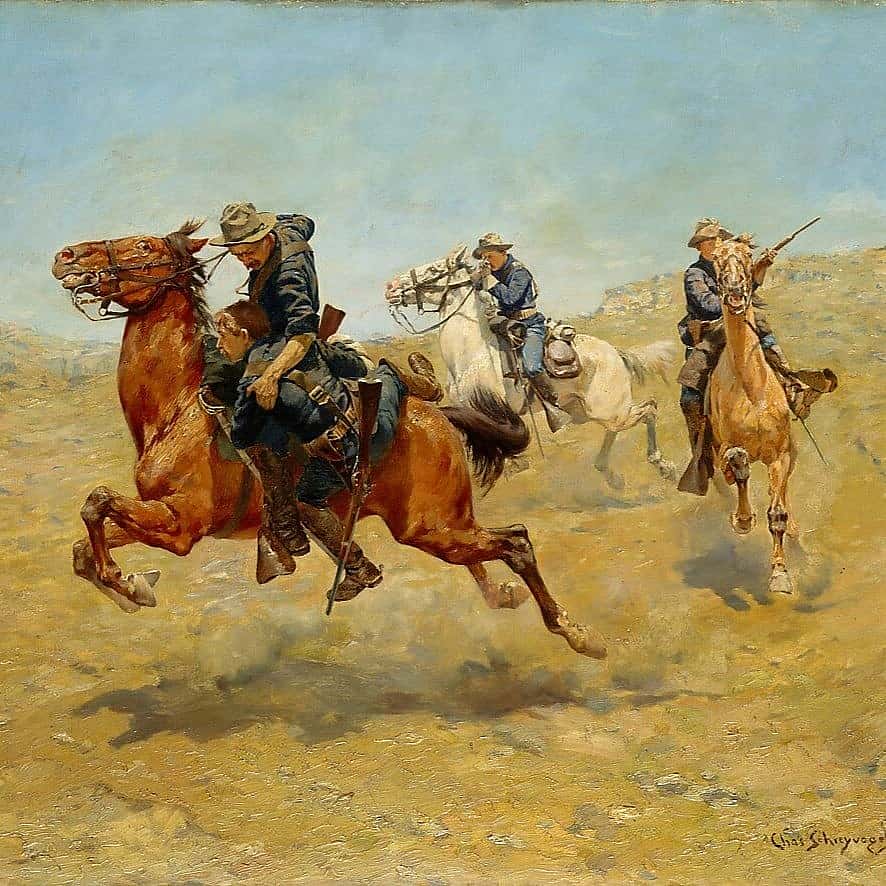
By the turn of the century, Schreyvogel’s artistic output and renown rivaled that of Fredric Remington (much to Remington’s chagrin) and Leslie’s Weekly, a prominent literary and news magazine at the time, called him “America’s greatest living interpreter of the Old West.” My Bunkie, his most famous painting, depicts a U.S. cavalryman rescuing a fellow soldier in the heat of battle, winning Schreyvogel the highly coveted Thomas B. Clarke prize. Such a tense and heroic moment captured the hearts and minds of Americans for its historical accuracy and patriotic sentiment, humanizing the calvary’s role within the broader context of the Indian Wars.

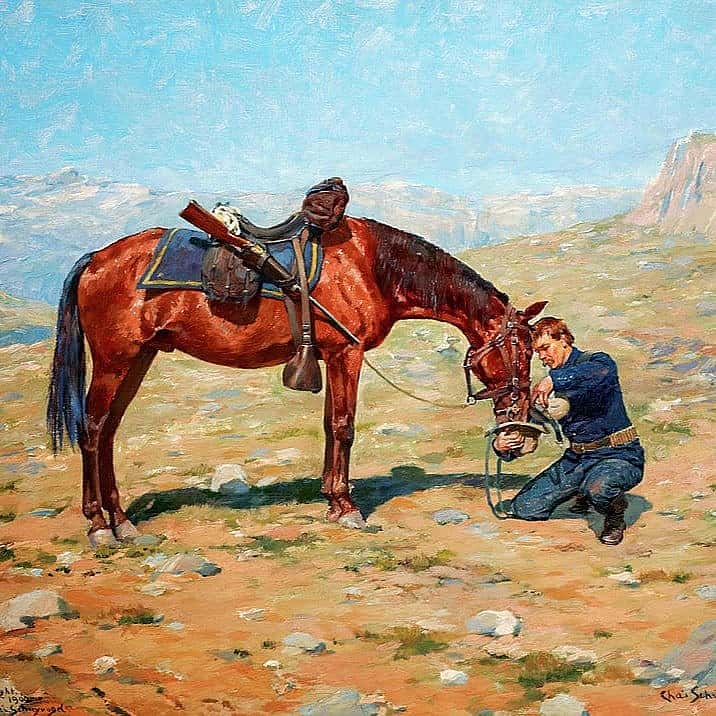
The Last Drop, one of only three sculptures that Schreyvogel produced, evolved from his painting with the same title; a practice highly unusual since many artists produced sculptures to study light, anatomy, and dimensions before painting. Both the painting and the sculpture portray the tender scene of a cavalryman using a hat as a water vessel for his thirsty horse. Since most western works focused on conflict and often depicted heroic tension, The Last Drop upends the narrative by depicting a soldier demonstrating compassion and sacrifice. First cast by the Roman Bronze Works in 1903, visitors can view this iconic and distinctive sculpture (cast #72) on display in the Whitney Western Art Museum at the Buffalo Bill Center of the West, a gift of Mr. and Mrs. Ernest J. Goppert, Sr.

The Last Drop by Charles Schreyvogel (detail). Public domain
The Last Drop by Charles Schreyvogel (detail). Public domain.
My Bunkie by Charles Schreyvogel (detail). Public domain.

A Western Legacy

Charles Schreyvogel died of blood poisoning in Hoboken, NJ in 1912. He left behind a catalogue of highly detailed, historically accurate, and artistically daring work, providing an invaluable historical lens for one of the most thrilling periods in American history.

The Last Drop. Charles Schreyvogel. Copyright 1903, bronze cast edition #72, Roman Bronze Works, NY. Gift of Mr. and Mrs. Ernest J. Goppert, Sr. Whitney Western Art Museum.

Written By

Jane Gilvary avatar

Jane Gilvary

Jane Gilvary is a Content Specialist in the Public Relations Department at the Center of the West. She writes and manages web content and serves as editor of the Center’s monthly e-newsletter, Western Wire. Outside of work, Jane enjoys exploring Wyoming’s backcountry and discovering its hidden treasures.

You May Also Like