Exclusive Tour Invitation
Join us for an exclusive tour of the McCracken Research Library at the Center of the West in Cody, Wyoming. This tour begins in the Buffalo Bill Museum, where we’ll head straight to the lower level to enter the world of the McCracken Research Library. Stay together as we pass Buffalo Bill’s family treasures and the Wild West Show diorama on our way to the staircase near the yellow Deadwood U.S. Mail coach.
Entering the McCracken Research Library
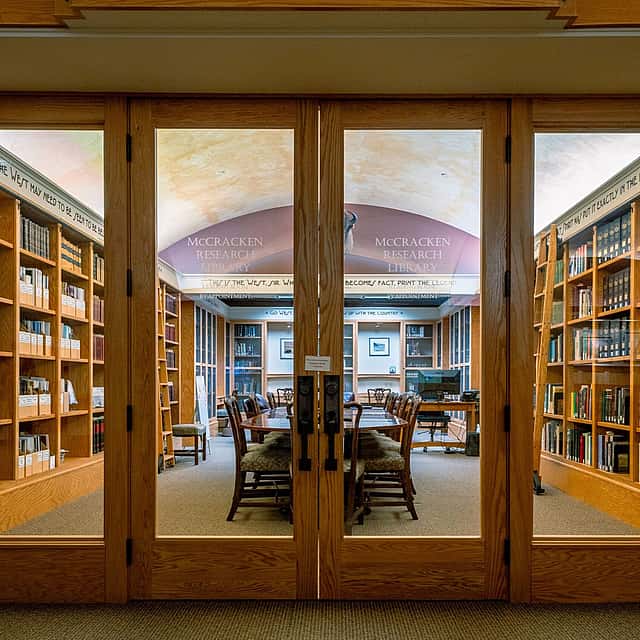
Let’s take a left turn and descend down the stairs into the world of the McCracken Research Library. Here we are met by the Gallery of Gunfighters display as well as cases filled with interesting western memorabilia. At the bottom of the stairs, we take a left turn into the “The Last Word on the West,” the McCracken Research Library.
Honoring Dr. Harold McCracken
Dedicated in 1980, our special collections library is named in honor of Dr. Harold McCracken (1894–1983), the founding director of the Whitney Western Art Museum and of the then-named Buffalo Bill Historical Center. Dr. McCracken played an instrumental role in what many describe as “presenting authentic western history,” and he led the creation of the original Whitney Museum collection in 1959.
Collections and Resources
At the McCracken Research Library, visitors will find 600+ numbered archive collections and one million digitized photos within the archives. The library portion of the McCracken boasts 37,000 books in-house, inclusive of the Reading Room, where anyone can wander in and use the resources there.
Rare Book Collections
The Reading Room houses part of the Rare Book Collections here in McCracken. Included behind these locked cases is the first edition of the published Lewis & Clark Expedition (c. 1814), History of the Expedition Under the Command of Captains Lewis and Clark, to the Sources of the Missouri: Thence Across the Rocky Mountains and Down the River Columbia to the Pacific Ocean; Performed During the Years 1804-5-6; By Order of the Government of the United States., famed photographer Edward Curtis’ copy of Encyclopedia of North American Indian Dictionary (try saying that three times fast).
Also found here is Frederic Remington’s Pony Tracks (1895) and set number 329 of 500 of Edward S. Curtis’ The North American Indian: Being a Series of Volumes Picturing and Describing the Indians of the United States, and Alaska (1907). Rare treasures, indeed, and only the tip of the proverbial iceberg here in the McCracken.
The Asahel Curtis Postcard Collection
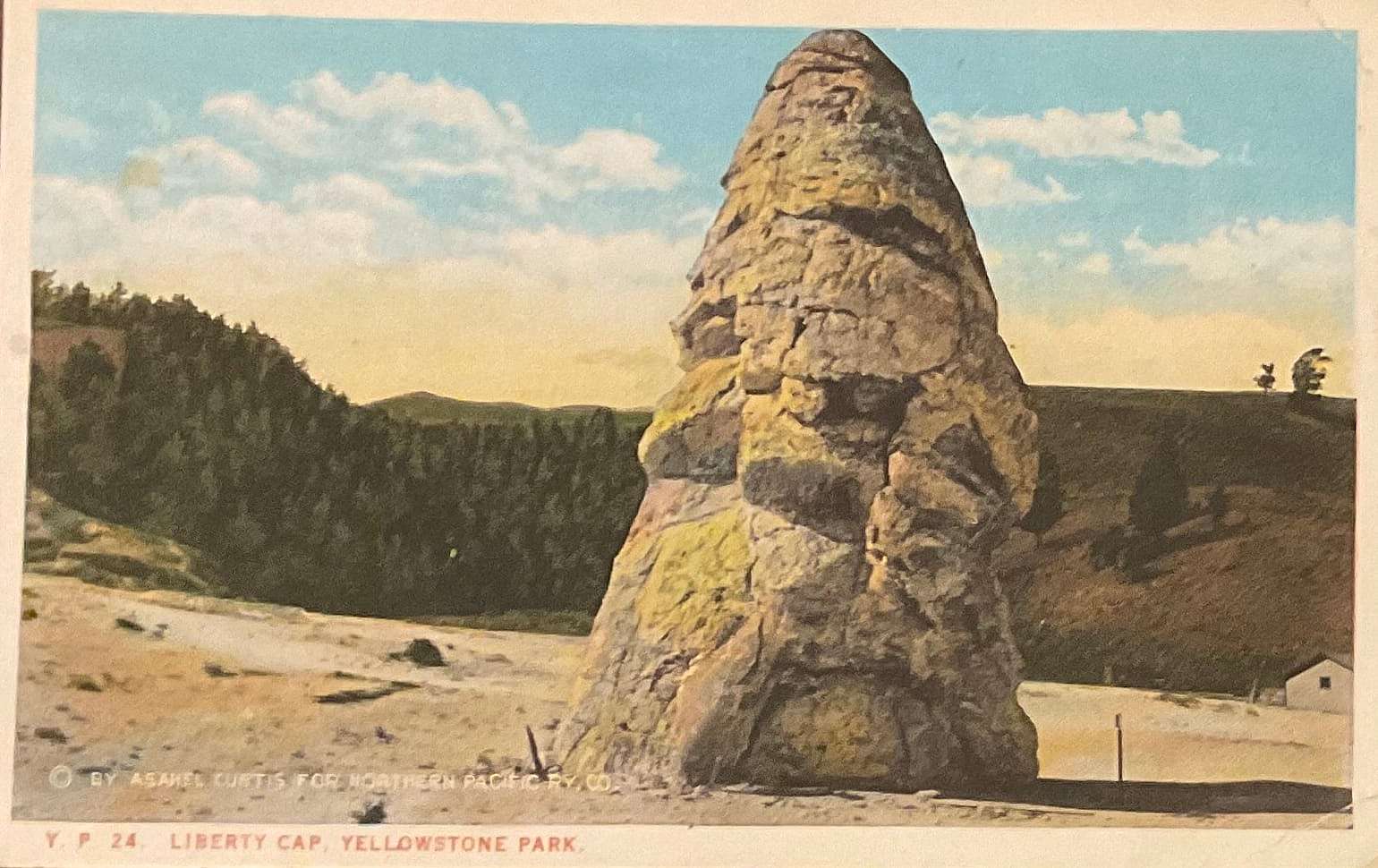
On the large research table, sits an archival box waiting for us. It contains 17 postcards from the Asahel Curtis Postcard Collection (MA 561) of Yellowstone Park, the nation’s first National Park—established in 1872. The postcards are part of a special collection from the Yellowstone series dating from 1897 to well into the mid-1970s featuring several different photographers from over the years. Postcards from Yellowstone have been studied and collected into the 21st century because of their nostalgic and wistful appeal to an era of antiquity unknown to many of us. The postcards feature many attributes found in Yellowstone in the late 19th and early 20th century including animal life, geology, and water scenery.
Yellowstone Animals and Scenic Views
The animal set in this collection includes bison, bighorn sheep, and bears. One of the bear postcards features an unsuspecting human family feeding some bears at their camp picnic table. The caption on the back of the card reads:
“Y. P. 34. Setting the Table for Bears at Lake Camp, Yellowstone Park. The bears are very amusing, interesting, and companionable, many of them, also voracious eaters. Quite mannerly at table — sometimes. Always ready to eat.”
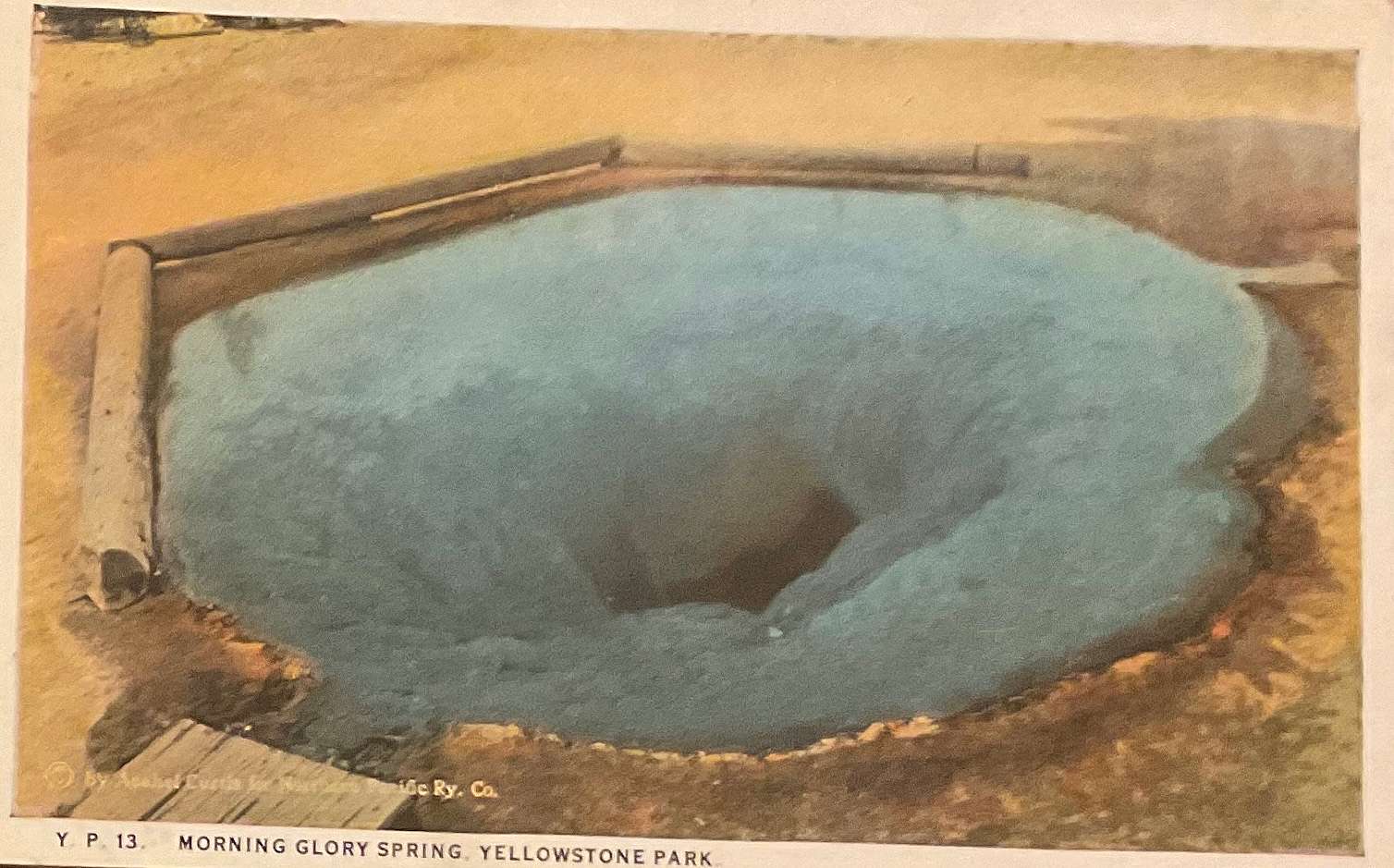
Has this family considered what these bears might always be ready to eat? The “Y.P.” designation you may have also noticed is part of the Yellowstone Park numbering system for these cards so that the collector may organize the different sets. For example, the postcards of water scenery included in this particular archive collection are the Morning Glory Spring (Y.P. 13), Sapphire Pool and Biscuit Basin (Y.P.17), Emerald Pool (Y.P. 16), Fishing Cone (Y.P. 5) and Handkerchief Pool (Y.P. 4).
Handkerchief Pool: A Quirky Yellowstone Story
“What is a Handkerchief Pool?” you ask. According to the back of the postcard:
“In Upper Geyser Basin is a feature of great attraction. Handkerchiefs are laundered at no expense and no waste of time, by Nature.”
Along with the laundry, other garbage and bits that visitors had were also thrown into the hot geyser. Handkerchief Pool was officially closed in 1928 because of visitor mischief, yet this wonderful postcard still survives to tell us this unique story.
Meet Asahel Curtis (1874–1941)
Equally wonderful to the story of these postcards on the table is that of their photographer, Asahel Curtis. Curtis was an American photographer known for his photos of the natural beauty of the Pacific Northwest landscapes and what may also be described as everyday photos of people living their lives in the early 20th century. Also an active outdoorsman and mountaineer, Curtis promoted greater accessibility of the public to nature’s spaces.
Curtis’ photography studio was active for thirty years with his photography being described as “being empathetic to what real people experienced in their lives.” Curtis’ body of work runs the gamut of images which include logging, maritime activity and fishing, mining, railroads and streetcars, schools, churches and street scenes. Through his photography, Curtis documented nearly every aspect of Seattle’s growth and renewal across all races, cultures, and socioeconomic groups, capturing an ‘unfiltered, uncensored history’ of what people were doing, what they were wearing, as well as scenic views of Washington, Alaska, and, of course, Yellowstone Park.
Further Study: Online Collections
For further study, the University of Washington houses the Asahel Curtis Photo Company Photographs’ digital collection and provides public access to 1,600+ items of photographic records of Curtis’ work from the 1850s to 1940. Also, the official website of Yellowstone National Park (through the U.S. Department of the Interior) has thirty postcard images to explore online. Visitors can browse the Curtis collection at the McCracken and also discover some of the other 158 archived postcards. The subjects of these cards range from horse trick-riding, Native American life, and Buffalo Bill. We can pair a tour of the McCracken with one of the other museums at the Center of the West.
Plan Your Visit
Exclusive Tours invites visitors to tour the McCracken Research Library, browse other archival collections of the McCracken Research Library online, or come in person to work with the wonderful archivists and librarians here in Cody, Wyoming. You are in for a treat no matter which method you choose to explore the hidden treasures within the Buffalo Bill Center of the West.