
Following the Herd: How the Social Lives of Buffalo Shape the Prairie

Abstract:
For thousands of years before their near-extinction in the 1800s, enormous herds of bison moved and grazed across the Great Plains, creating a mosaic of habitats. Now, there is growing momentum behind restoring bison to their native landscapes. But in modern, managed settings, can bison still fill their historic role as ecosystem engineers? The Smithsonian’s Great Plains Science Program, working with partners including American Prairie and Tribal Nations in northern Montana, is studying how bison reintroduction affects everything from bird communities and streamside vegetation to soils and insects. This talk will address what it is about bison movement and behavior that produces these effects. Bison live in fission-fusion societies where groups merge and split apart over time. How many bison are in a group changes how intensively they graze, so these social decisions have direct implications for the landscape. By analyzing GPS tracks and behavioral observations, we are finding that bison social structure is surprisingly flexible and closely tied to the distribution of resources in their environment. Beyond grazing, bison also reshape the prairie through wallowing, a rolling behavior that creates patches of bare, depressed soil that serve important ecological functions. We are mapping these features with drone imagery to better understand where they occur and at what scale. As bison reintroduction projects grow across the region, understanding how bison behave and modify their environment is key to restoring not just this iconic species, but the ecological role they once played.
Bio:
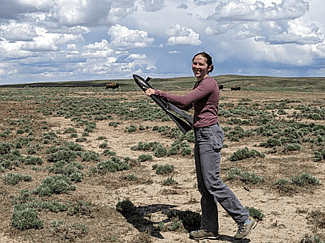
Claire Bresnan is a doctoral candidate in Ecology at Montana State University and a fellow with the Smithsonian’s National Zoo and Conservation Biology Institute. Based in Bozeman, Montana, her research focuses on bison social organization and movement, and how these behaviors shape the landscapes where bison are being restored. Her work takes place at American Prairie in north-central Montana, where she uses diverse methods, including GPS tracking, behavioral observations, camera traps, drone surveys, genetic analyses, and vegetation chemistry to untangle the complex interactions between bison behavior and grassland function. Beyond her research, she has co-developed field courses and integrated survey data into interactive coursework with faculty at Aaniiih Nakoda College on the Fort Belknap Indian Reservation. Claire grew up in the Washington D.C. area and is incredibly grateful that her connections with the Smithsonian led her to discover the beauty of Montana’s prairies and to work with a species that, in addition to their ecosystem impacts, means so much to so many people.