
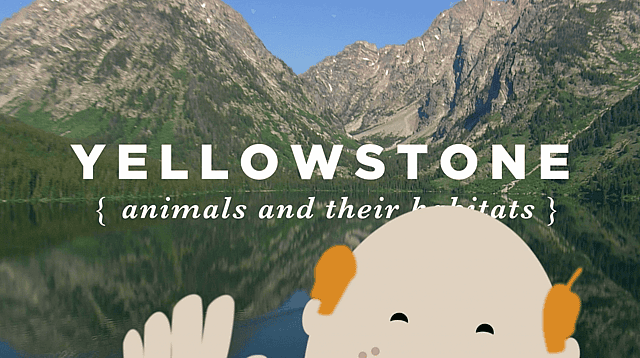
Museum Education for Kids

August 4, 2015

When I began my internship at the Buffalo Bill Center of the West this summer, I was tasked with creating educational video content for a K-5 audience (the video is embedded at the bottom of this article). Before I went to work, I opened up my Moleskine notepad and created this simple, short list:
1. Bill Nye (a.k.a. the Science Guy)
2. Neil DeGrasse Tyson
3. Spongebob Squarepants
You might think one of these characters doesn’t belong. The first two, Bill and Neil, are masters of their craft, taking the most complex scientific and historical topics and boiling them down to their most essential points so even kids can understand them.
The third, who I’ll refer to simply as “Spongebob,” was the most important figure on my list. He reminds me of my childhood—a time when my imagination and silliness were completely uninhibited. It was a time when I knew how to be a kid.
In order to make educational content for a kid, I had to think (and sometimes, act) like a kid. Here are three steps I used to guide my creative and educational process during the creation of this video:
1. Keep it simple.
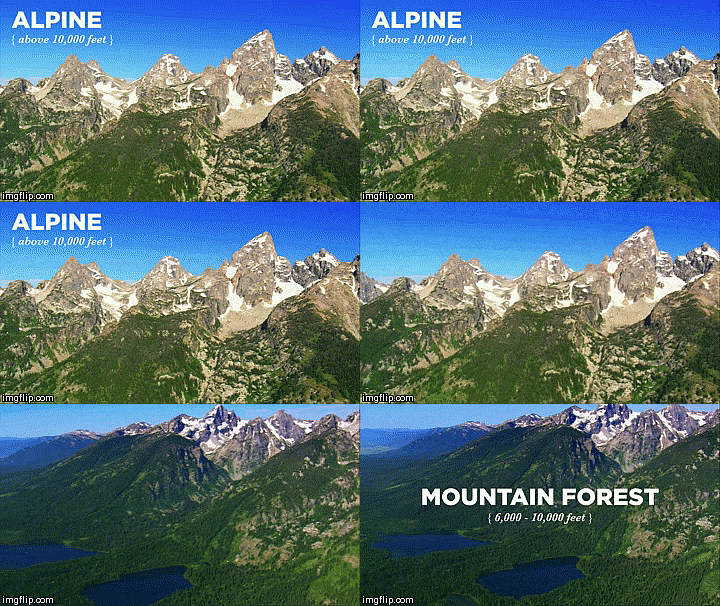
Simple vocabulary, simple structure, simple concepts. Not simple to a mind-numbing degree; kids are smarter than their untied shoes and boogers let on. They can grasp fairly complex words and concepts, and use their imaginative and curious minds to find the answers to their burning questions. Simplicity is more about the clear, concise organization of thought, placing concepts into a simple blueprint that kids can follow and understand. That’s why I use list formats and clear, concise labels throughout the video.
2. Keep it visual.

I know what you’re thinking: “Of course he’s keeping it visual. He made a video!” But not all videos are created visually equal, especially when it comes to educational video.
Do you remember your days as a child when your teacher would tell you to remember a spelling word, but you could never quite keep it in your brain? But when you actually “see” the word—letters on a screen (or paper, for old-school folks), right before your eyes—it’s twice as easy to remember the word. Suddenly, you have two associations with the word—an audible one, and a visual one. Twice the associations leads to twice the permanence in your brain.
I tried to line up these two associations—so kids hear “habitat” while the word “habitat” is on the screen—so they’re more likely to connect the word with its sound and its meaning. This strategy creates multiple associations with any concept, and helps appeal to multiple learning styles.
In terms of non-educational, technical aspects of the video, I gave the video a colorful, fun, and energetic feel. While substance is important, so is style.
3. Keep it unapologetically silly.

During the making of this video, I couldn’t help but feel like I was making a fool of myself. It all felt so silly to me. My concept? Silly. My voiceover? Silly. My script? Educational—and equally silly. I couldn’t help but wonder what my peers and colleagues would think of a work that, in terms of the Center of the West, is uncharacteristically cheesy, disruptive, and unscholarly.
But this video isn’t for my peers and colleagues—it’s for elementary school kids. They’re the silliest cohort of human beings on earth.
One of the employees in the education department has an eight-year-old daughter. When she visits the office, she bounces off the walls, explores every nook and cranny of the office, and giggles for no apparent reason. She’s sharp as a tack, and unapologetically silly. Over the summer, she’s been a reminder of my audience—a symbol for everything I’ve worked so diligently to create. She kept me silly.
When you keep it silly, kids will engage with the content you create—and when they engage, they learn. That’s the goal of educational content, isn’t it?
As I finish my internship next week, and return to Colorado for the final semester of my not-so-silly college career, I’ll always remember what I’ve learned in my time at the Center of the West. I’ve improved my video production and education skills immensely, and learned a lot about working in the museum industry. But most of all, I’ve learned that sticking to my guns (or in this case, lists) is wiser than I imagined.
Until next time, Center of the West. Until next time, Cody, Wyoming. If you see me out there in the world, I’ll be keeping it silly.
CHECK OUT THE VIDEO HERE:
Written By
Levi Meyer
Levi Meyer, a Cody, Wyoming native, was formerly the PR & Marketing Manager at the Buffalo Bill Center of the West.
You May Also Like
How the Rocky Mountains Formed: A Journey Through Changing Scientific Ideas
Dec 11, 2025

"Science is finding out where we're wrong." -J. Robert Oppenheimer...
Scout, Warrior, Witness: The Legacy of White Man Runs Him
Jul 22, 2025

Governor Frank Emerson shaking hands with White Man Runs Him...
4 Videos for a Greater Understanding of the Greater Yellowstone Ecosystem
Jul 19, 2019

The Greater Yellowstone Ecosystem is rife with eye-catching scenery and...
Nature in Many Languages: An Interview with James Prosek
Sep 08, 2016
James Prosek. Yellowstone Composition No. 1, 2016. Mixed media on...
Looking Back, Moving Forward: A Decade of Ashley Hlebinsky
Jul 10, 2020
After nine-and-a-half years as part of the Center of the West family,...
20 Greatest Western Films of All Time
Apr 30, 2020
The 20 Greatest Westerns Ever Made Our museum's curators, historians,...
Revolutionary Readers: The Library as a Symbol for Freedom
Jul 30, 2026

Dr. Harold McCracken in his home library in Cody, Wyoming...

Buffalo Brief: Prepping Wildlife Skeletons for Display
Jul 23, 2025

Editor’s Note: This story includes descriptions and images of preparing...
Don’t Let History Live in a Shoebox: How to Archive Your Family Treasures
Sep 18, 2026

Are you the designated "historian" in your family? Do you...
The Life Style of Yellow-bellied Sapsuckers
Sep 16, 2026

Tree girdled with Yellow-bellied Sapsucker Holes © Dennis Donohue /...