Wyoming is one of North America’s great wildlife destinations. Across the Greater Yellowstone Ecosystem, bison graze
open valleys, elk move between mountain meadows and winter ranges, bighorn sheep navigate steep canyon walls, and
grizzly bears roam a vast landscape of connected habitat.
For families and travelers visiting Cody, Wyoming, the opportunities to experience this remarkable wildlife are closer than
you might think. The road from Cody toward Yellowstone’s East Entrance follows the North Fork of the Shoshone River
through the Wapiti Valley, one of the region’s most accessible wildlife corridors.
Before heading into the field, make the Draper Natural History Museum at the Buffalo Bill Center of the West your first
stop. Through immersive exhibits, scientific collections, live raptor programs, and ongoing research, the Draper helps
visitors understand the animals, habitats, and ecological relationships they may encounter between Cody and Yellowstone.
Use this Wyoming wildlife guide to learn where to look, when to look, how to identify some of the region’s most
fascinating animals, and how to enjoy wildlife without disturbing it.
Best Times and Locations for Wildlife Viewing Near Cody
The best wildlife viewing begins with habitat. Rather than simply searching for a particular animal, look for places where
water, food, shelter, and seasonal movement come together. River bottoms, willow flats, sagebrush benches, forest edges,
rocky slopes, and open mountain meadows can all provide excellent habitat. One of the best places to begin wildlife
viewing near Cody is the North Fork Highway along the Shoshone River.
North Fork of the Shoshone River
U.S. Highway 14/16/20 follows the North Fork of the Shoshone River west from Cody through the Wapiti Valley toward
Yellowstone National Park’s East Entrance. Along the way, travelers pass a landscape that provides habitat for elk, grizzly
bears, bighorn sheep, moose, deer, and numerous other species. Look across brushy slopes and grassy benches for elk and
mule deer. Scan steep cliffs for bighorn sheep. Willow-lined river bottoms can provide habitat for moose and beavers,
while the skies and tall riverside trees may reveal bald eagles, golden eagles, ospreys, and red-tailed hawks.
Black bears, wolves, and mountain lions also inhabit the broader landscape, although sightings of these elusive animals
are never guaranteed. The goal should be to observe wildlife safely from an appropriate distance rather than stopping or
approaching simply to improve a view.
Dawn and Dusk: Understanding Crepuscular Wildlife
Early morning and evening can be especially productive times for wildlife viewing. Many animals are crepuscular,
meaning they are particularly active around dawn and dusk. Cooler temperatures and reduced human activity can
encourage animals to move and forage.
Low-light conditions, however, also create additional hazards on the road. Slow down, watch carefully for animals
entering or crossing the roadway, and use established pullouts whenever stopping. Never stop in a travel lane or create a
dangerous situation for other drivers.
A distant, safe observation is always better than a close encounter created by crowding an animal or blocking traffic.
Seasonal Wildlife-Viewing Patterns
Spring brings new growth and increased movement toward emerging vegetation. Elk and deer may be accompanied by
young later in the season, while bears search for grasses, roots, winter-killed animals, and other available foods. Give
mothers and young animals exceptional space.
Summer often rewards early risers. Elk may move through higher meadows and forest edges, bison graze open grasslands,
and birds become active around rivers and nesting habitat. Wildlife activity can decrease during the heat of the day.
Fall brings the elk rut, when bulls become especially vocal and defensive. Migrating animals begin moving toward lower
elevations, while bears spend more time feeding as winter approaches. Never approach a feeding bear or an animal
carcass.
Winter can make wildlife tracks easier to spot and may concentrate ungulates on windswept slopes and lower-elevation
winter ranges. Weather and road conditions can change rapidly, so check current conditions before traveling.
Greater Yellowstone Ecosystem Mammals Field Guide
The Greater Yellowstone Ecosystem supports an extraordinary diversity of mammals. Learning a few basic field marks
and understanding where different species live can make a wildlife-viewing trip much more rewarding.
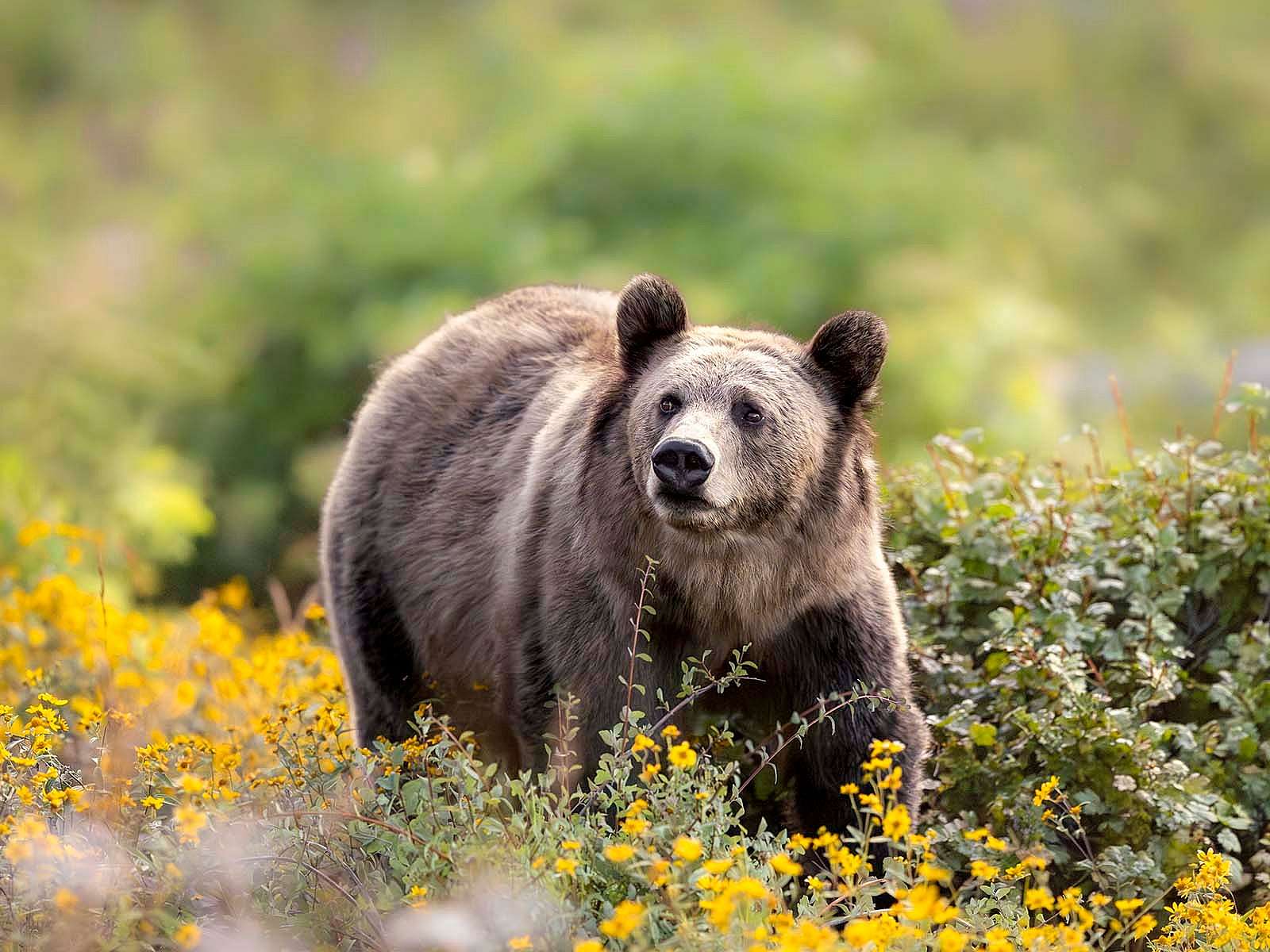
Grizzly Bears
Grizzly bears are powerful omnivores whose diets change with the seasons. In spring, they may feed on grasses, roots,
winter-killed animals, and newborn ungulates. Later in the year, berries, insects, army cutworm moths, and whitebark pine
seeds can become important food sources.
Grizzlies occur throughout the Greater Yellowstone Ecosystem, including portions of Shoshone National Forest. Look for
a prominent shoulder hump, a dished facial profile, and relatively long, straighter front claws. Coat color alone is not a
reliable way to distinguish a grizzly from a black bear.
Give grizzlies plenty of room. In Yellowstone National Park, visitors must remain at least 100 yards away from bears, and
bear spray should be immediately accessible when traveling in bear country.
Black Bears
Black bears are common throughout the Greater Yellowstone region, particularly in forests and along forest edges. Despite
their name, black bears may be black, brown, cinnamon, or blond, so color is not a dependable identification feature.
A black bear generally lacks the pronounced shoulder hump of a grizzly and has a straighter facial profile and shorter,
more curved claws. Black bears eat a wide variety of foods, including vegetation, berries, insects, small mammals,
carrion, and pine seeds. Treat every bear as potentially dangerous. Never feed a bear, and never leave food, coolers, pet
food, or garbage unattended.
Gray Wolves
Gray wolves live in family-based packs whose members cooperate in raising young, defending territory, and hunting.
Yellowstone wolves primarily prey on elk, although bison and other animals can also become part of their diet.
Wolves use howling to communicate within the pack, coordinate activity, and advertise territory. Wolves were restored to
Yellowstone beginning in 1995, returning a native apex predator after decades of absence. Seeing one requires patience,
good habitat, and plenty of luck. Binoculars or a spotting scope can help you observe distant wolves without disturbing
them.
American Bison
Bison have lived continuously in the Yellowstone landscape since prehistoric times. Yellowstone preserves the largest
bison population on public land in the United States and the only continuously free-ranging population in the lower 48
with roots extending back to prehistoric herds.
Bison often gather in herds but may spread across grasslands and sagebrush while grazing on grasses and sedges. During
the summer rut, bulls compete for access to cows and can become particularly unpredictable. Never mistake a resting or slowly grazing bison for a tame animal. Bison are powerful, agile, and capable of running approximately 30 to 35 miles per hour.
In Yellowstone, remain at least 25 yards away. Never stand in a bison’s path, and move farther away if an animal raises its
tail, paws the ground, tosses its head, or changes its behavior because of your presence.
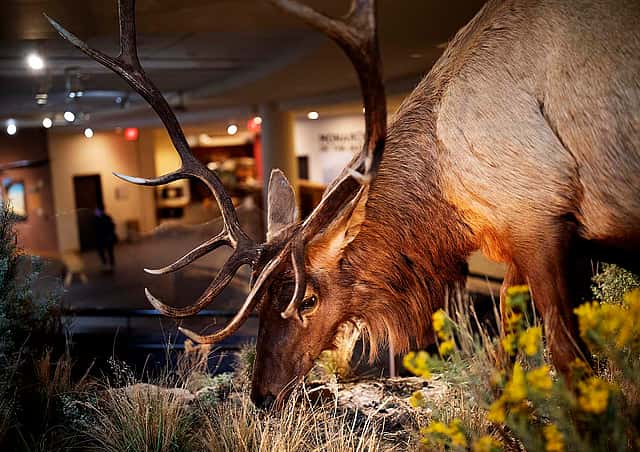
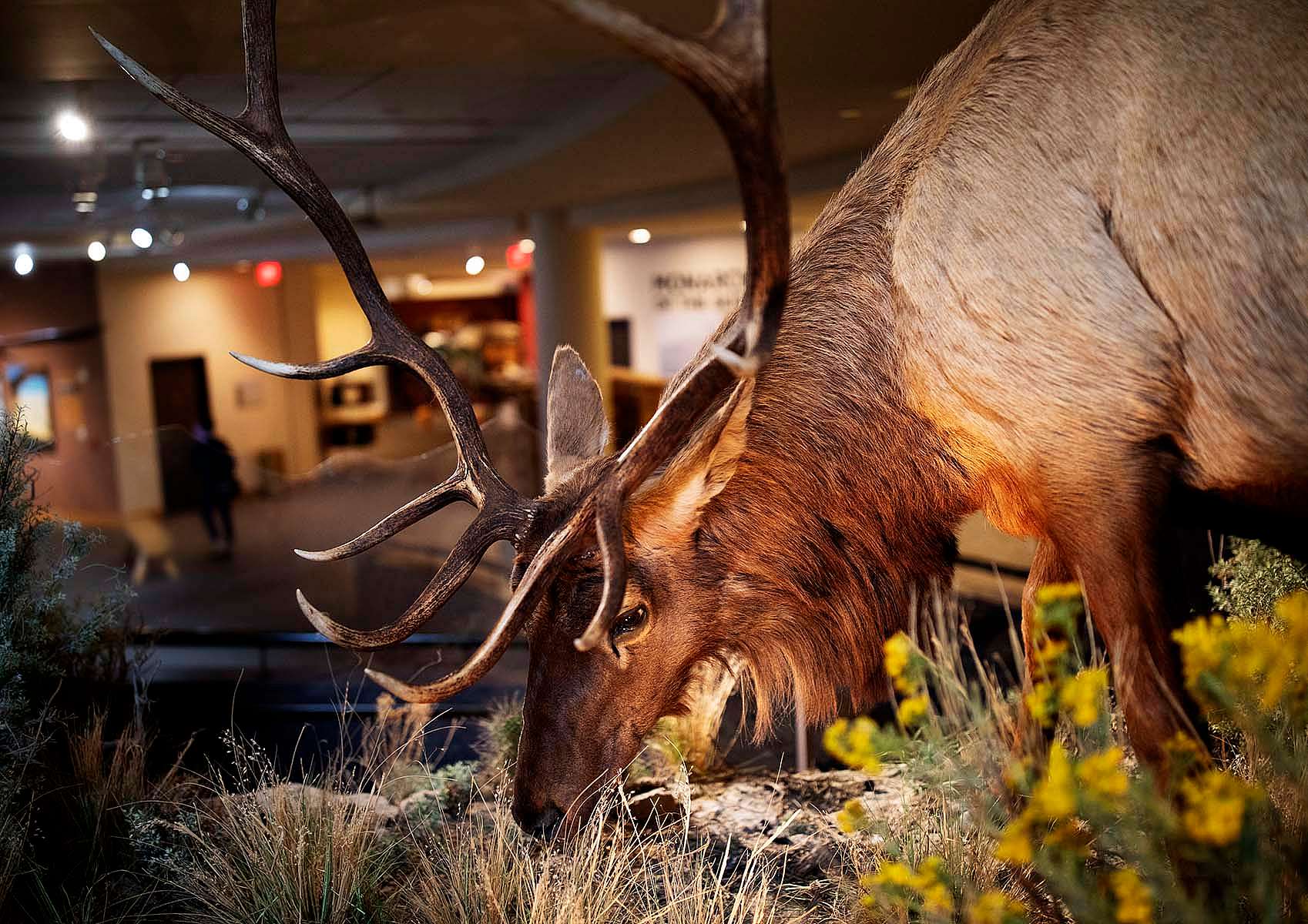
Elk
Elk are the most abundant large mammal in Yellowstone and an important part of the Greater Yellowstone food web. The park provides summer range for an estimated 10,000 to 20,000 elk from several herds, many of which migrate to lower
elevations outside the park during winter.
Around Cody and along the North Fork, look for elk on open hillsides, river terraces, forest edges, and brushy winter
ranges. The September and October rut is an especially memorable time to hear elk bugling. Bulls, however, can become defensive during this period, so give them substantially more space than the minimum required distance.
Moose
Moose are the largest members of the deer family. Their long legs and broad, splayed hooves allow them to move through
snow, mud, shallow water, and wet vegetation.
Look for moose in willow bottoms, river valleys, wet meadows, and forest openings, particularly where dense cover is
nearby. Their dark bodies can blend remarkably well into shaded vegetation. Moose are not slow or harmless. Cows may
aggressively defend calves, and bulls can become unpredictable during the rut. Keep your distance and retreat if a moose
pins its ears, raises the hair on its neck, lowers its head, or walks toward you.
Bighorn Sheep
Bighorn sheep are built for steep, rocky terrain. Their flexible hooves help them negotiate ledges and slopes that appear
nearly vertical.
In the Wapiti Valley, scan cliff bands, rocky canyon walls, and open slopes above the highway rather than looking only
across the valley floor. Both rams and ewes carry permanent horns. Rams typically develop the large, curling horns
associated with the species, while ewes have shorter, more slender horns.
The best way to watch bighorn sheep is from a legal pullout with binoculars. Never climb toward sheep or crowd animals
near a roadway.
Pronghorn Antelope
Pronghorn are the fastest land mammals in North America, an adaptation associated with the open landscapes where they
evolved. Their extraordinary speed and exceptional eyesight help them detect danger across sagebrush plains and
grasslands. Although commonly called antelope, pronghorn belong to their own family. They carry true horns rather than
antlers, and the horn sheath is shed and regrown.
Look for their tan bodies and distinctive white rump patches in open sagebrush country. Observe them from the road or a
legal pullout without interrupting their movement.
Mule Deer
Mule deer get their name from their oversized ears, which can rotate toward faint sounds. Other useful field marks include
a pale rump, narrow black-tipped tail, and distinctive bounding gait.
Near Cody, look along broken valley terrain, sagebrush grasslands, brushy slopes, and low-elevation winter ranges. Dawn
and dusk can be productive times to search for mule deer.
Never approach deer for a photograph. Their presence may also signal habitat used by predators such as mountain lions
and coyotes.
Mountain Lions
Mountain lions, also called cougars or pumas, are solitary and elusive predators. Most visitors never see one, even in areas
where mountain lions are present.
Their tawny coats, quiet movements, and preference for cover make them difficult to detect. In the Greater Yellowstone
Ecosystem, cougars primarily prey on deer and elk, and their ranges can follow the seasonal movements of those animals.
Treat a rare sighting as a wildlife encounter rather than a photo opportunity. Maintain a safe distance, never run, keep
children close, and follow current agency guidance if a cougar approaches.
Coyotes
Coyotes are adaptable canids found in habitats ranging from sagebrush flats and open meadows to forest edges and
developed landscapes.
They eat a wide variety of foods, including small mammals, rabbits, insects, carrion, and other available prey. Their yips,
barks, and howls can make a small number of coyotes sound like a much larger group. Dawn and dusk are good times to
listen for coyotes, although they can be active at any hour. Never feed them or allow them to associate people, roads, or
campsites with food.
River Otters
River otters are active members of the weasel family adapted to cold water. Their streamlined bodies, webbed feet, dense
waterproof fur, and muscular tails make them excellent swimmers.
Along the Shoshone River and mountain streams, watch for sleek heads at the surface, groups traveling together, tracks
near open water, and slides along muddy or snowy banks. Healthy aquatic ecosystems provide the food and habitat river
otters need, making these animals an intriguing part of the Greater Yellowstone wildlife experience.
American Beavers
Beavers are ecosystem engineers. By cutting woody vegetation, building dams, diverting water, and creating ponds, they
can alter stream structure and create habitat used by fish, amphibians, waterfowl, insects, and wetland plants.
Beavers are often most active around morning and evening. Look for gnawed willow stems, dams, ponds, bank dens,
lodges, and the unmistakable slap of a tail against the water. Do not walk on dams or disturb lodges. Observe from shore
without blocking access to the water.
American Pikas
American pikas are small relatives of rabbits that live among talus slopes, boulder fields, and alpine and subalpine
rockslides.
Their gray-brown coats blend into stone, so visitors may hear a sharp whistle before spotting one. Pikas do not hibernate.
Instead, they gather grasses, flowers, and other vegetation during the growing season and store the dried plants beneath
rocks as winter food. Look and listen from the edge of a talus slope rather than climbing across loose rock or approaching
a pika’s haystack.
Greater Yellowstone Birds and Raptors Field Guide
Wildlife viewing in Wyoming is not limited to mammals. Yellowstone and the surrounding Greater Yellowstone
Ecosystem support hundreds of bird species, including eagles, hawks, falcons, owls, waterfowl, and songbirds.
The Shoshone River, Buffalo Bill Reservoir, mountain cliffs, forests, wetlands, and sagebrush country around Cody offer
countless opportunities to watch birds.
Bald Eagles
Bald eagles are closely associated with rivers, lakes, and reservoirs. In the Greater Yellowstone region, they feed primarily
on fish but may also take waterfowl and carrion.
Along the Shoshone River and Buffalo Bill Reservoir, scan tall riverside trees, shoreline snags, and the sky above open
water. Adult bald eagles have distinctive white heads and tails. Younger birds remain mostly brown and mottled for
several years.
Want to see a bald eagle up close without approaching one in the wild? Meet the avian ambassadors of the Draper
Museum Raptor Experience.
Golden Eagles
Golden eagles favor open country near mountains, cliffs, escarpments, and broad sagebrush landscapes. They hunt rabbits,
hares, ground squirrels, marmots, grouse, and other prey.
Around Cody, scan cliff ledges and open skies above canyons and sagebrush plains. Adult golden eagles have dark heads
and tails, distinguishing them from adult bald eagles.
Peregrine Falcons
Peregrine falcons are among the fastest animals on Earth. They can reach approximately 55 miles per hour in level flight
and exceed 200 miles per hour during a hunting dive.
Peregrines nest on cliffs and rocky gorges, making canyon country around Cody and the Greater Yellowstone Ecosystem
suitable habitat. Their recovery is a major conservation success. After severe twentieth-century declines associated in part
with pesticide contamination, habitat protection, captive breeding, and reintroduction helped peregrine populations
recover. The species was federally delisted in 1999.
Osprey
Osprey are fish specialists easily recognized by their white underparts, white heads with dark eye stripes, and long, narrow
wings. Watch above the Shoshone River, Buffalo Bill Reservoir, and other open water. An osprey may hover briefly
before plunging feet-first toward a fish. Large stick nests may appear in trees, on poles, or on artificial platforms. Observe
nests from a distance because repeated disturbance can cause adults to leave eggs or young exposed.
Red-Tailed Hawks
Red-tailed hawks are among the most visible raptors in the American West. Look for them perched on utility poles, fence
posts, roadside trees, and other elevated locations overlooking sagebrush flats and open slopes.
Adults often have a brick-red upper tail, although plumage varies. Broad rounded wings, a relatively short tail, and a
heavy-bodied silhouette can also help with identification.
Great Horned Owls
Great horned owls are powerful nocturnal hunters found in forests, cottonwood groves, wetlands, grasslands, agricultural
areas, and even towns.
Listen after dark for a series of deep hoots. During daylight, look for a large owl silhouette in dense branches or listen for
crows mobbing a hidden owl.
Do not use recorded calls to provoke a response. Playback can disturb territorial and nesting birds and is prohibited in
Yellowstone.
Greater Sage-Grouse
Greater sage-grouse depend on extensive sagebrush landscapes for food, nesting cover, brood-rearing habitat, and winter
shelter.
In early spring, males gather before and around sunrise on traditional display grounds called leks. They fan their tails,
sweep their wings, inflate yellow air sacs, and produce distinctive popping sounds while females evaluate the displays.
View sage-grouse only from approved locations and distances. Vehicles, people, and noise can disrupt breeding behavior.
Trumpeter Swans
Trumpeter swans are North America’s largest wild waterfowl, with wingspans that can approach eight feet. Adults are
white with black bills, while young birds are gray.
Look for them on quiet lakes, wetlands, and slow-moving rivers. During winter, geothermal influence can keep portions of
some Greater Yellowstone waters ice-free, providing important habitat when other waters freeze.
Never approach a nest or force a family group away from a feeding area.
Responsible Wildlife Viewing: Keeping It Safe and Wild
The best wildlife encounter is one in which the animal never changes its behavior because of your presence.
Inside Yellowstone National Park, visitors must stay at least 100 yards from bears, wolves, and cougars and at least 25
yards from other wildlife. The National Park Service also emphasizes that visitors should move away whenever their
presence causes an animal to react or change its behavior.
Follow these essential wildlife-viewing practices:
- Stay at least 100 yards from bears, wolves, and cougars.
- Stay at least 25 yards from other wildlife, including bison, moose, elk, and deer.
- Increase your distance if an animal is agitated, protecting young, moving toward you, or attempting to cross a
road or trail.
- Never feed wildlife.
- Secure food, garbage, coolers, pet food, and scented items.
- Use designated pullouts and never stop in a travel lane.
- Never surround an animal or block its path.
- Remain in or near your vehicle when it provides the safest viewing opportunity.
- Never pursue wildlife for a photograph.
- Keep pets controlled and follow posted leash regulations.
- Carry bear spray in bear country and keep it immediately accessible.
- Report wildlife conflicts or injured animals to the appropriate agency rather than attempting to handle an animal
yourself.
Remember: if an animal repeatedly looks at you, stops feeding, changes direction, vocalizes, moves away, or otherwise
reacts to your presence, you may already be too close.
Essential Gear for Safe Wildlife Photography
The safest wildlife close-up is created with optics, not proximity. Binoculars can reveal details that are impossible to see
with the naked eye, while a telephoto lens allows photographers to fill the frame without approaching an animal. The
National Park Service recommends binoculars and telephoto lenses for wildlife viewing and notes that a lens of 300mm or
greater can provide useful reach.
For a family wildlife trip in Wyoming, useful equipment can include binoculars, a spotting scope, a telephoto lens, a
tripod or monopod, a window mount or beanbag for photography from a parked vehicle, extra batteries, memory cards,
and a field guide or identification app.
The most important rule is simple: zoom with your lens, not with your feet. Never bait an animal, play recorded calls,
crowd a nest, leave a designated road or pullout to improve an image, or violate wildlife-distance requirements for a
photograph.
Experience Wildlife Up Close at the Draper Natural History Museum
Wild animals belong in the wild, where they can behave naturally and move freely. At the Draper Natural History
Museum, visitors can examine the details they could never safely approach outdoors, from a grizzly bear’s claws and a
wolf’s skull to the shape of an eagle’s beak.
The Draper’s Greater Yellowstone Adventure begins at the Expedition Trailhead and continues along the Alpine-to-Plains
Trail. Visitors move through recreated alpine, mountain-forest, meadow, and plains environments while encountering the
plants, animals, sounds, and ecological relationships that define the Greater Yellowstone Ecosystem.
Hands-on geological samples, specimen drawers, immersive habitats, and a large ecosystem map help children connect
individual animals with the landscapes they need to survive.
The Draper is also an active scientific institution. Its natural history collections support research, exhibitions, and
education, while current projects investigate regional biodiversity and conservation questions. Research includes the
Absaroka Bat Census and the Pinyon Jay Project.
Meet Live Birds Through the Draper Museum Raptor Experience
For another unforgettable wildlife experience, visit the Draper Museum Raptor Experience. The program introduces
visitors to non-releasable avian ambassadors while trained staff explain raptor adaptations, behavior, conservation, and
individual care. Birds participating in the program have included bald and golden eagles, peregrine falcons, red-tailed
hawks, great horned owls, kestrels, and other species. Program times and participating birds can change, so check the
current schedule before visiting.
Wyoming Wildlife FAQs
What Is the Best Place to See Wildlife Near Cody, Wyoming?
The North Fork of the Shoshone River and Wapiti Valley along U.S. Highway 14/16/20 form one of the most accessible
wildlife corridors near Cody. Depending on the season and chance, travelers may see elk, mule deer, bighorn sheep,
moose, bears, eagles, and other species.
What Is the Best Time of Day to See Wyoming Wildlife?
Dawn and dusk are often productive because many species are crepuscular or become more active during cooler, low-light
periods. Wildlife can appear at any time, however, and habitat and season are often more important than a particular time
on the clock.
How Far Should I Stay From Wildlife in Yellowstone?
Stay at least 100 yards from bears, wolves, and cougars and at least 25 yards from other wildlife inside Yellowstone
National Park. If an animal moves closer, back away to restore the required distance. These are enforceable minimums
inside Yellowstone and useful safety benchmarks elsewhere, subject to local regulations.
What Wildlife Can I See Between Cody and Yellowstone?
The Wapiti Valley provides habitat for elk, deer, moose, bighorn sheep, black and grizzly bears, wolves, mountain lions,
coyotes, beavers, otters, eagles, hawks, falcons, owls, and many other species. What you see depends on season, weather,
habitat, time of day, and chance.
Where Can Children Learn About Yellowstone Wildlife Safely?
The Draper Natural History Museum in Cody offers immersive Greater Yellowstone habitats, hands-on learning, natural
history specimens, research interpretation, and live educational birds through the Draper Museum Raptor Experience.
What Camera Lens Is Best for Yellowstone Wildlife?
The National Park Service recommends binoculars or telephoto lenses rather than approaching wildlife and notes that
focal lengths of at least 300mm can provide useful reach. A longer lens can help with distant animals, but no photograph is
worth violating wildlife-distance rules.
Start Your Wyoming Wildlife Adventure in Cody
Wyoming wildlife is best experienced with patience, curiosity, and respect. The animals of the Greater Yellowstone
Ecosystem are not attractions waiting beside the road. They are part of a complex, living landscape shaped by habitat,
seasons, migration, weather, food, and ecological relationships.
Before heading toward Yellowstone, take time to understand that landscape at the Buffalo Bill Center of the West. Explore
the Draper Natural History Museum, meet the birds of the Draper Museum Raptor Experience, and then take what you
have learned into the field.
When you know what you are looking at, where to look, and how to give wildlife the space it needs, every sighting
becomes more meaningful.
For help planning the rest of your visit, explore the Center’s Cody itinerary resources and make the Buffalo Bill Center of
the West part of your Wyoming adventure.