
Speaking in Code: Rare Winchester Telegraph Code Books

June 30, 2026
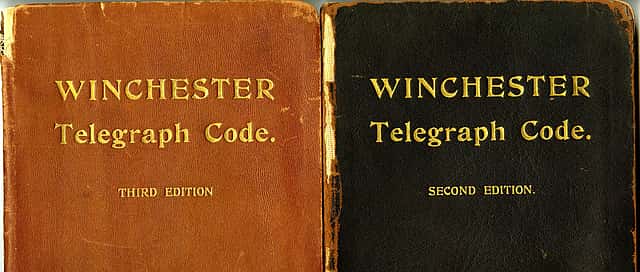
Among the rarest items in the McCracken Research Library’s archival collections are three Winchester Telegraph Code Books from 1905 and 1909. At first glance they look like ordinary reference books with worn leather bindings, yellowed pages, and page after page of seemingly random words. Hidden inside, however, is a secret language that once helped the Winchester Repeating Arms Company conduct business across the United States and around the world long before telephones, emails, and computers.
Although modest in appearance, these volumes preserve a forgotten communication system that allowed Winchester employees, distributors, and dealers to exchange detailed business information quickly, accurately, and economically using the telegraph.
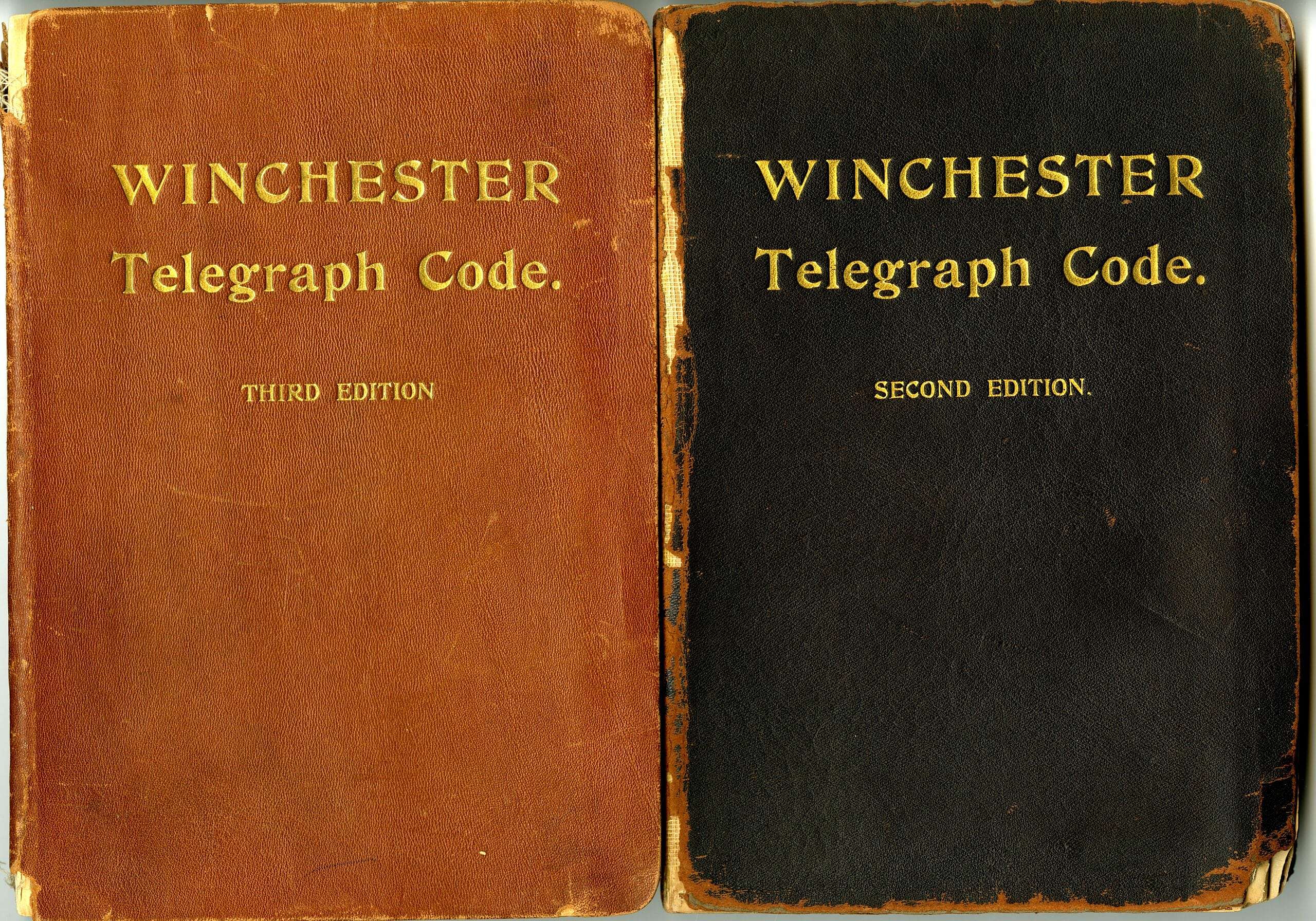
These books raise two fascinating questions: why did a firearms company need its own coded language? And why are these books so rare?
By the turn of the twentieth century, Winchester was one of the best-known firearms manufacturers in the world. Its rifles, shotguns, ammunition, and sporting goods moved through an extensive network of manufacturers, distributors, wholesalers, retailers, and sporting goods dealers across the United States and around the world.
Managing a network of that scale required a constant flow of information and communication. Orders needed to be placed, inventory checked, shipments tracked, prices updated, and warehouses instructed on what products to send and where they should go. Every one of those messages had to travel hundreds or even thousands of miles. Before telephones became commonplace, the fastest way to move information was by telegraph – fast, but certainly not cheap. Telegraph companies charged per word, meaning lengthy business correspondence could become expensive very quickly.
To reduce telegraph costs, many businesses adopted commercial telegraph codes, while others, including Winchester, developed proprietary code books tailored specifically to their own business operations. Rather than paying to transmit an entire paragraph, a single code word could now represent a complete sentence, shipping instruction, product description, quantity, or a business response at a fraction of the cost.
Imagine a Winchester salesman in Montana needing to order a shipment of rifles and ammunition. Instead of telegraphing a lengthy message back to the factory in New Haven, he could send a handful of carefully chosen code words. Back at the New Haven factory, a Winchester employee using the same code book could translate those words back into detailed order instructions. Now, what might otherwise require dozens of words, and dozens of telegraph charges, could be communicated in just a few.
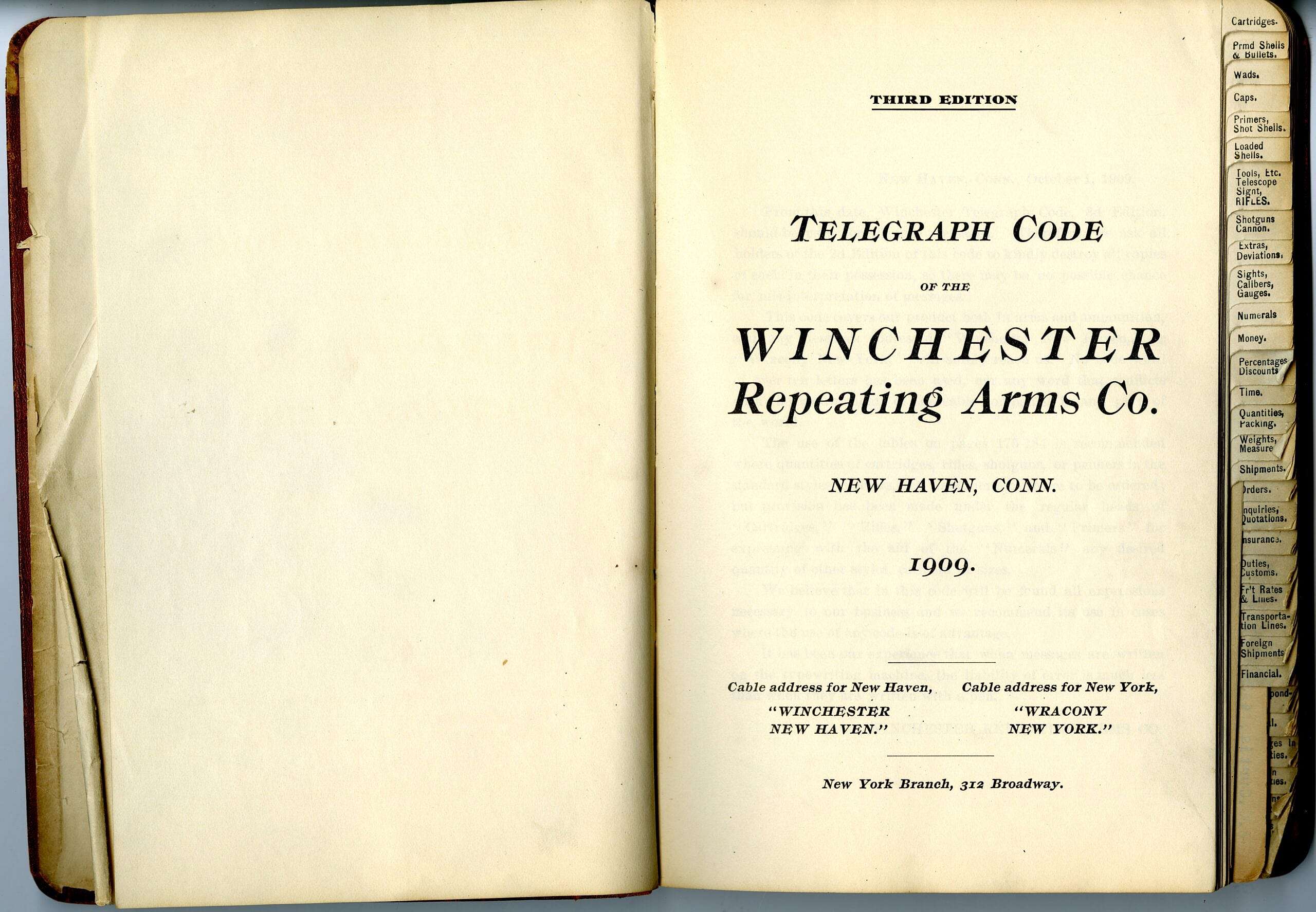
The first page of both the 1905 Second Edition and 1909 Third Edition of Winchester’s Telegraph Code Book open with the same instructions: “From this date all code messages should be based on the [current] edition. We therefore ask all holders of the [past] edition to kindly destroy all copies in their possession, in order that there may be no possible chance for mis-interpretation of messages.”
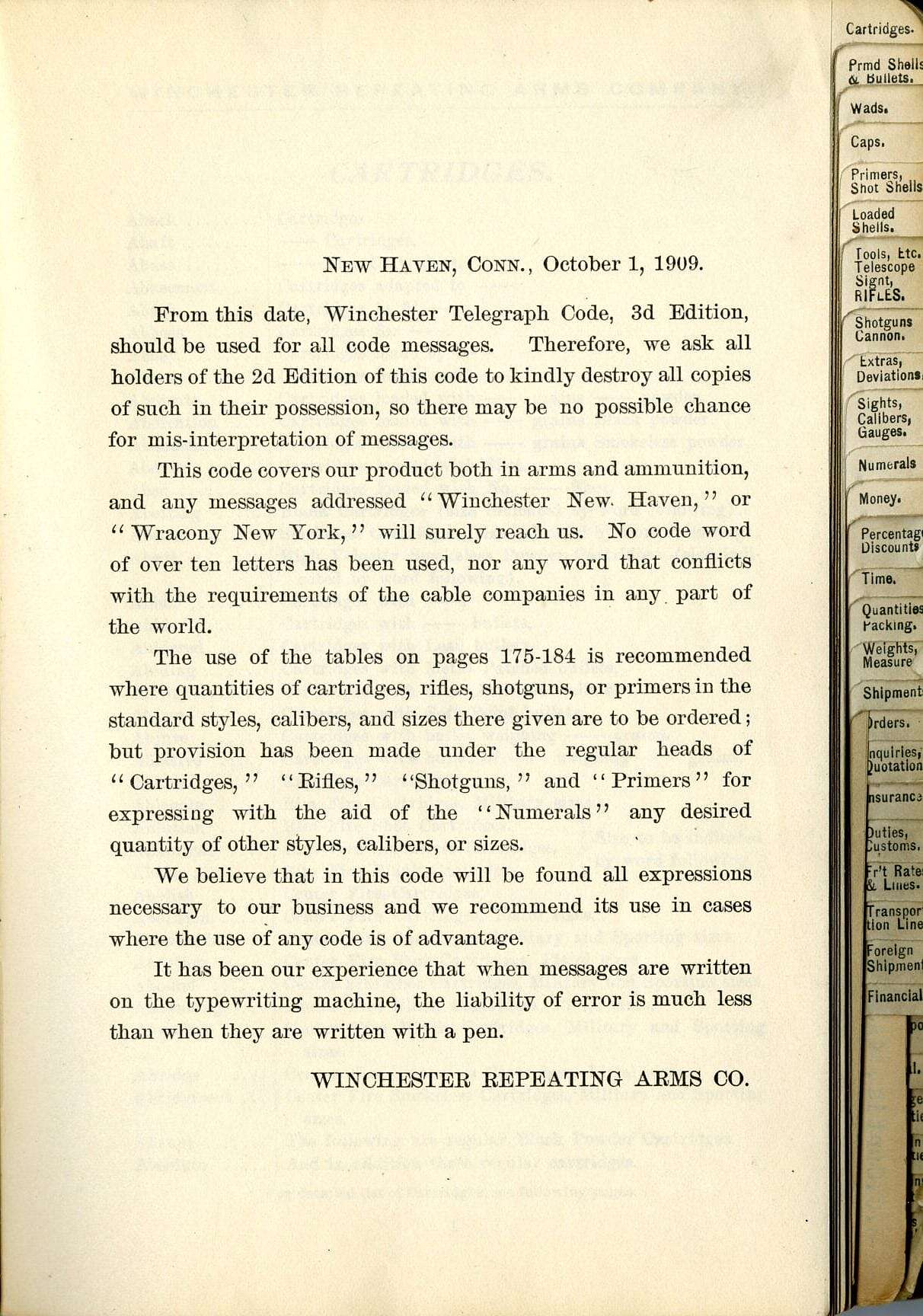
This single instruction helps explain why Winchester Telegraph Code Books are so uncommon today. Because every edition of the code books represented a standardized language shared throughout the company, outdated copies posed a genuine risk to Winchester’s business operations. Even small changes between editions could result in costly misunderstandings. Rather than allow old versions to remain in circulation, Winchester instructed users to destroy previous editions entirely.
For archivists and historians, this request is both remarkable and our worst fear. The company itself encouraged the destruction of the very books that now provide insight into its business operations.
The introductory page reveals far more than just instructions for using the code. Winchester notes that its code complied with the requirements of cable companies “in any part of the world,” suggesting their communication system was intended for both domestic communication and international business. The company further states that the code book “covers our goods in both arms and ammunition” and “contains all expressions necessary to our business:”
In effect, Winchester encapsulated an entire manufacturing and distribution operation into a specialized vocabulary. Every product, shipment, order, quantity, and routine business transaction could be expressed through code words. The result was an efficient and cost-effective operating system for one of America’s largest firearms manufacturers.
The introduction also offers an unexpected glimpse into another challenge of early business communication: human error. Winchester advised that “It has been our experience in writing messages that the use of the typewriting machine renders the liability of error much less than if the original messages are written with a pen.”
Anyone who has ever struggled to decipher hurried handwriting can appreciate the concern. In a communication system where every letter mattered, an unclear handwritten word could become an expensive mistake once transmitted hundreds of miles by telegraph. Winchester’s recommendation to type messages reflects the company’s commitment to making its coded communication as accurate as it was efficient.
While the exact number of surviving Winchester Telegraph Code Books is unknown, Winchester historians and collectors believe only a handful remain. If true, the McCracken’s three copies represent one of the largest known institutional holdings. Their presence in the collection is thanks to the generosity of Jeff Weber and Daniel Shuey, donors who understood the importance of preserving these remarkable examples of Winchester history and ensuring they remain available for future research.
Can You Crack the Code?
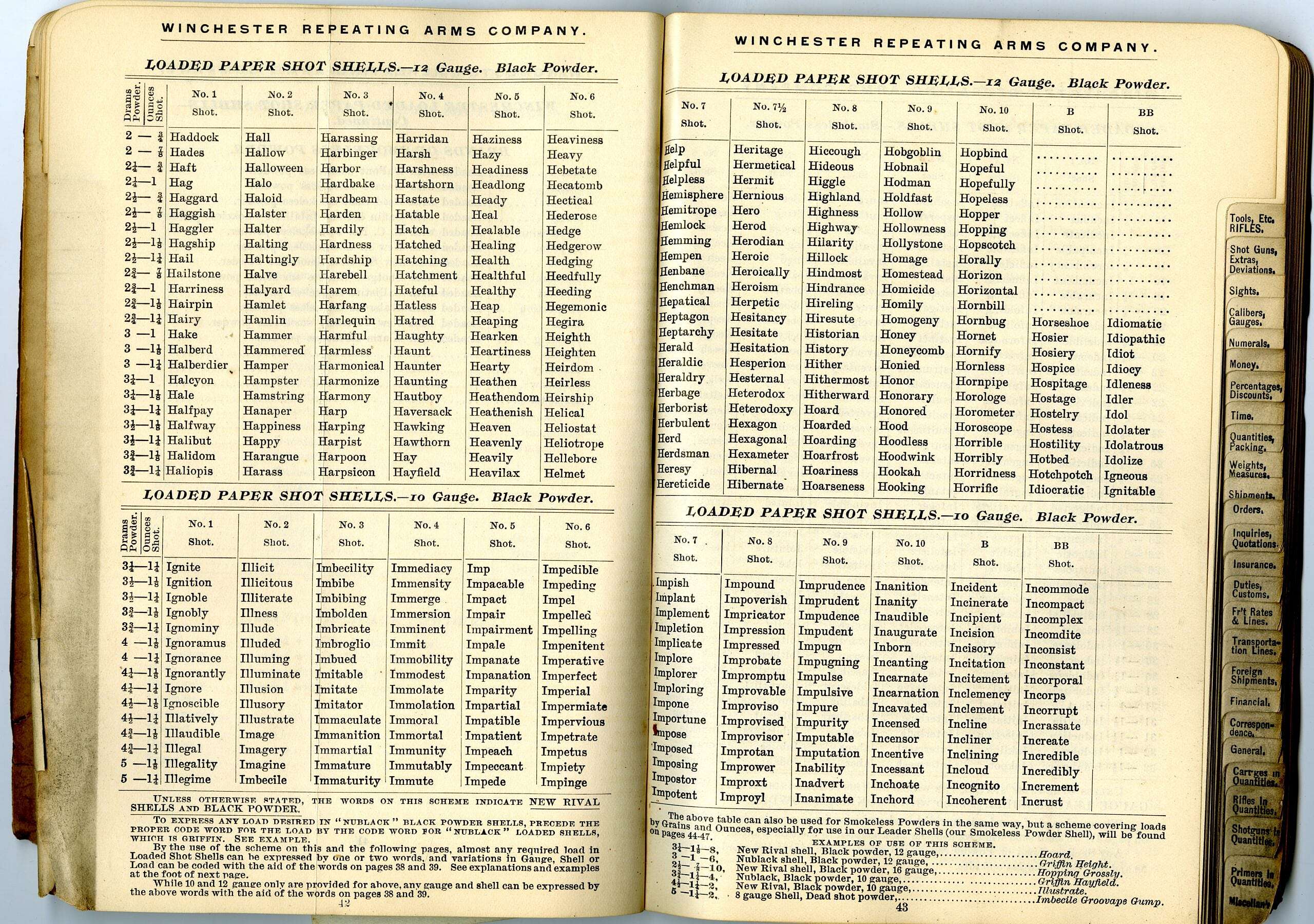
Imagine you’re a Winchester dealer in 1909. A customer wants 10-gauge loaded paper shot shells with a 3½ dram powder charge and No. 8 shot.
Using the page from the 1909 3rd edition code book below, what single code word would you send to Winchester? (Answer located beneath the photograph.)
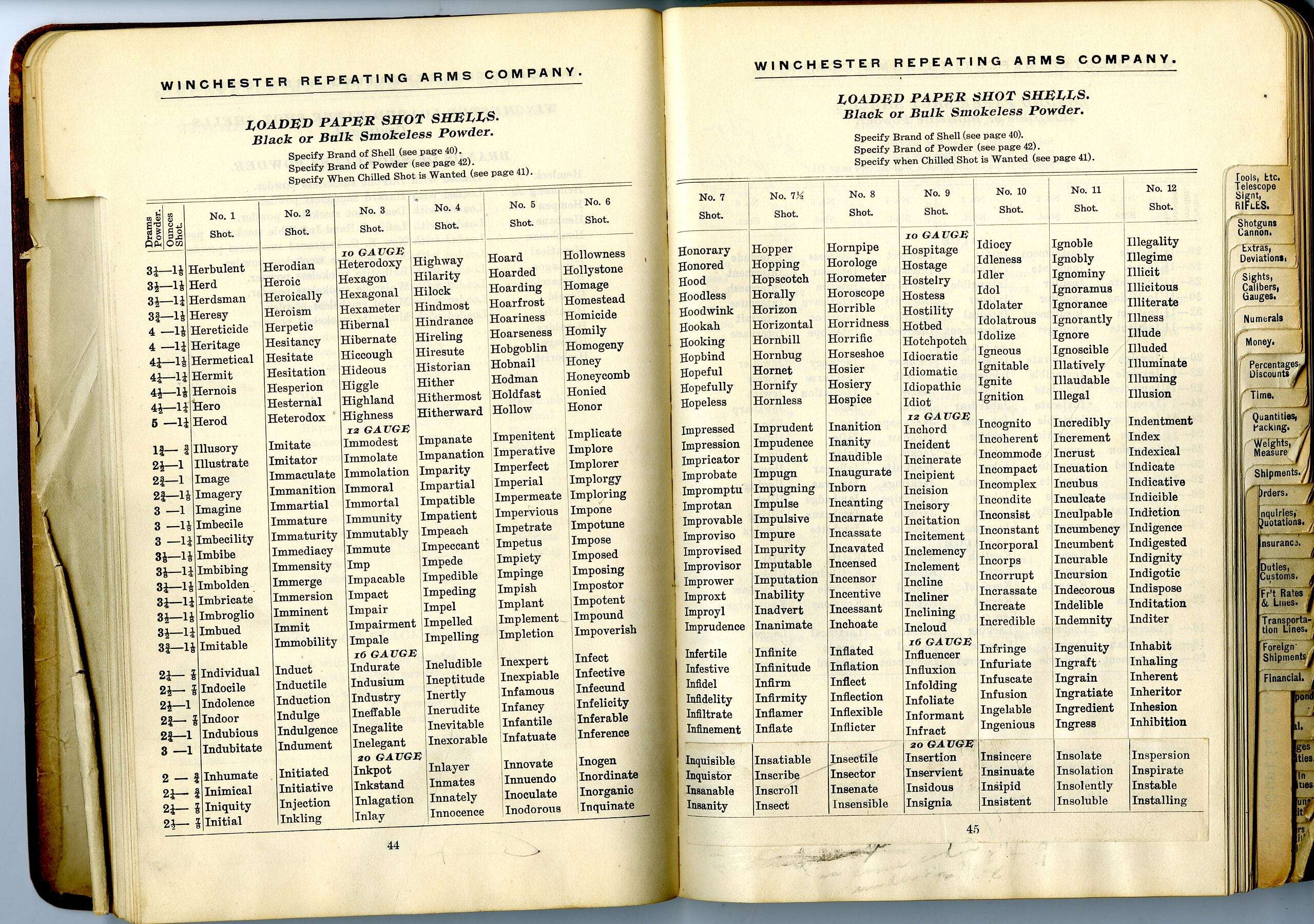
The answer is: Horoscope
Why?
- Find 3½–1⅛
- Move across to No. 8 Shot
- The intersecting code word is Horoscope
At first glance, these telegraph code books appear to be little more than worn notebooks filled with seemingly random words. Looking inside reveals a sophisticated communication system that helped the Winchester Repeating Arms Company connect their business across the globe. While these books were never intended to be historical documents, their preservation in the archive of the McCracken Research Library ensures that researchers and Winchester enthusiasts can continue to uncover hidden gems about the company and their role in the firearms world. Here in the library, we believe that sometimes the most remarkable stories are hidden inside the most unassuming books.

Written By
Cassandra Day
Cassandra Day is the Archivist of the McCracken Research Library at the Buffalo Bill Center of the West, where she specializes in the preservation, interpretation, and accessibility of historical records. She holds a Bachelor of Arts in History from Georgia Southern University and a Master of Science in Archival Studies from Clayton State University. Additionally, she is a Certified Archivist through the Academy of Certified Archivists. Her research interests include World War II and Cold War codebreaking, oral history methodologies and best practices, and the exploration of regional identities through rodeo. She is passionate about making archival materials accessible and engaging while preserving the voices and stories that shape our understanding of the past.
You May Also Like
Research Made Easy: Exploring the McCracken Research Library’s Collections
Mar 23, 2026

Archival and library research can feel overwhelming for even the...
The Myth of the Fully Processed Archive
Jul 20, 2026
When you think of an archive, you probably imagine countless collections all perfectly...
The Life Style of Yellow-bellied Sapsuckers
Sep 16, 2026

Tree girdled with Yellow-bellied Sapsucker Holes © Dennis Donohue /...
Don’t Let History Live in a Shoebox: How to Archive Your Family Treasures
Sep 18, 2026
Are you the designated "historian" in your family? Do you...
Heart Mountain Through the Lens
Jul 02, 2026
Each July, former detainees, their families and descendants, gather at...
Inside the Reading Room: What to Know Before You Visit
Feb 12, 2026
The McCracken Research Library has a reading room that is...
Rare Book Highlights: The Indians’ Book
Sep 02, 2026

"Wellnigh impossible is it for civilized man to conceive of...
The Secret Custer Letter: Rediscovering Little Bighorn at 150
Jun 02, 2026
Earlier this year, while reprocessing the MS 89 Jack Richard...
Buffalo Bill Center of the West Authenticates Trove of Historic Early 1800s Medals
Sep 08, 2026

Buffalo Bill Center of the West authenticates rare early 1800s...
From the Badlands to the Tetons: A 1930s Family Road Trip West
Sep 14, 2026
Long before smartphones and GPS guided travelers across the country,...
The Ultimate Wyoming Wildlife Guide: Expert Viewing Tips
Sep 28, 2026
Grizzly Flowers. Photo by Julia Cook @julia.littlelightningnature Draper Elk Wyoming...
Rare Book Highlights: The Original Journals of the Lewis and Clark Expedition
Oct 01, 2026
"If not for the … epic the captains scratched out...