
From the Cancan to the Wild West: The Remarkable Life of Giuseppina Morlacchi

July 14, 2026
The French didn’t bring the Cancan to America; an Italian did!
Giuseppina Morlacchi was an Italian ballerina trained at the renowned La Scala ballet school in Milan. Although she received initial acclaim in Italy, Paris, and London, earning the epithet “Morlacchi the Peerless” for her technical ability and beauty, she achieved widespread fame through her performances in the United States. After spending the ten years following her professional debut touring Europe, she was hired in 1866 to join De Pol’s Grand European Star Ballet Troupe and perform with them in the American musical extravaganza The Devil’s Auction; or, The Golden Branch, which opened at Banvard’s Opera House in New York City on October 23, 1867. Described by the New York Daily Herald and later echoed by The New York Times as the “Sensation of the Season,” The Devil’s Auction was a resounding success. After its run in New York, the production moved to Boston’s Theatre Comique before embarking on a national tour.
It was in Boston, as part of The Devil’s Auction, that Morlacchi and her fellow dancers introduced the Parisian Cancan to American audiences. Typically performed at the very end of the show because of the excitement it generated, the cancan quickly became one of the production’s most popular attractions. As the lead danseuse of the Grand European Star Ballet Company, Morlacchi is remembered as the performer most responsible for introducing the dance to the United States.
An article published in the Boston Evening Transcript describing Morlacchi’s return to the stage after a bout of illness praised the dancer:
“Mlle. Morlacchi will reappear at the Theatre Comique this evening. The manager’s announcement will gratify hosts of enthusiastic admirers whom this artist has gained in Boston. The combined ballet and pantomime, in which she is to appear this evening, is the best piece yet produced for her to exhibit the variety of her accomplishments. Having been written expressly for her and arranged by herself, every opportunity has been improved to bring out the different gifts she possesses. In variety of incident it is also quite entertaining.”
This review demonstrates the level of admiration Morlacchi had earned, particularly among Boston audiences. While she was consistently praised for her artistry and technique, the cancan itself was often viewed as controversial. Many journalists described it as “gross, indecent, and demoralizing.” One Boston writer even argued:
“It is the misfortune of this young woman to have encountered managers and a public taste that obliged her to appear in such an exhibition. It is my opinion that the grand jury would find a true bill under laws forbidding lewd and immoral exhibitions, or even under law against improper exposure of the person, were the character of this performance brought to its notice.”
The criticism is particularly striking given that, as the Boston Evening Transcript noted, Morlacchi herself arranged the choreography. Rather than being forced into the role by managers, contemporary evidence suggests that she played an active creative role in shaping the performance for which she became famous.
Morlacchi Takes the Lead
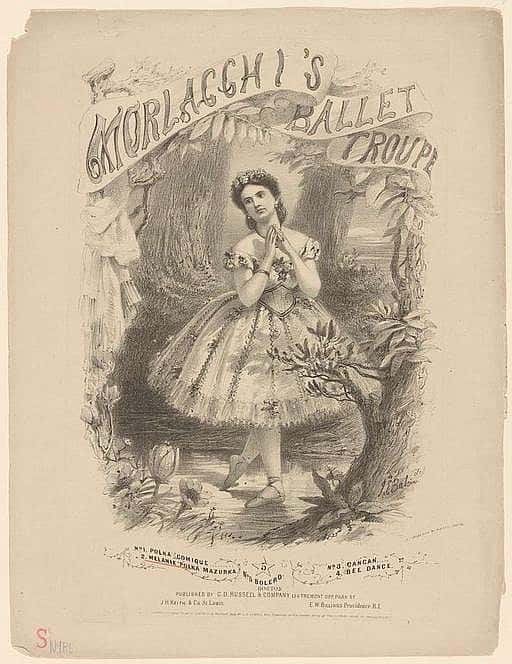
In 1868, Morlacchi, with the help of her agent Major John M. Burke, formed her own dance company, making her the first female founder and artistic director of a dance company in the United States—a distinction that is not often recognized. Within her company, Morlacchi continued to perform popular pieces such as the cancan, while also incorporating classical ballet works including Esmeralda and La Bayadère. Her troupe became a regular attraction at Boston’s Theatre Comique and also secured engagements in New York City, most notably at the Grand Opera House, where it appeared alongside productions of Shakespeare’s The Tempest and Offenbach’s La Périchole. These performances, coupled with Morlacchi’s consistently favorable reviews, demonstrate that the formation of her company was both a financial and personal success. More broadly, Morlacchi’s career challenges the assumption that women in the nineteenth century were excluded from positions of business ownership and artistic authority, illustrating how, contrary to popular belief, some women successfully navigated social constraints to establish influential and profitable enterprises.
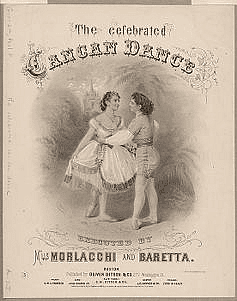
The above image appeared on the cover of sheet music for The Celebrated Cancan Dance (1868), depicting the dancers Giuseppina Morlacchi and Leopoldina Baretta, who were among those associated with early American performances of the cancan. Baretta appears in a male costume (en travesti), while Morlacchi wears attire more closely related to Romantic ballet than to the ruffled skirts later associated with the cancan. These costumes suggest that Morlacchi’s early American version of the dance may have differed visually from the form popularized in later decades. The depiction of the dance as a partnership rather than an all-female troupe suggests that the piece was not meant to be a provocative show. Additionally, the presence of Baretta, dressed en travesti, reflects the differences in nineteenth-century gender conventions.
Victorian society is often remembered as exceptionally conservative, yet the popularity of theatrical cross-dressing suggests that attitudes toward gender presentation may have been more flexible than modern stereotypes imply. Baretta’s appearance in male attire did not generate the same level of controversy as the cancan itself; critics instead focused on the dance’s perceived indecency and physical exposure. This contrast suggests that public anxieties were often directed more toward sexuality and bodily display than toward theatrical performances that blurred conventional gender boundaries. While an underlying theme of social rebellion remained, Morlacchi’s performances also emphasized theatrical display, ballet technique, and virtuosity. Given that the dance was presented in major theatrical venues and as part of organized stage productions, American audiences appear to have viewed it not only as a challenge to prevailing social conventions but, most prominently, as an impressive theatrical spectacle.
From Ballet to the Wild West!
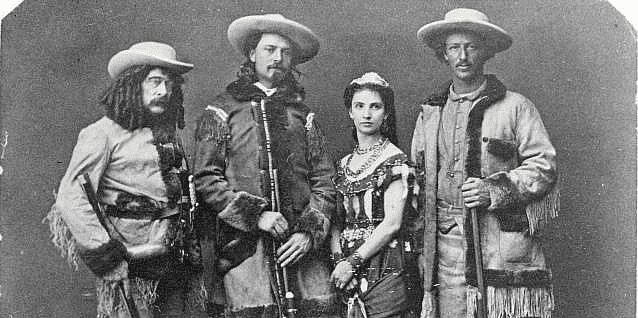
Performance culture in the nineteenth Century offered women unusual opportunities for public visibility. Morlacchi achieved widespread fame and recognition throughout the United States. She was so popular that, in 1872, she was asked to join Buffalo Bill Cody and his partner, Texas Jack, in a Western theatrical show called Scouts of the Prairie. Considered one of the first-stage Westerns, Scouts of the Prairie was based on Ned Buntline’s dime novel Buffalo Bill’s Last Victory; or, Dove Eye the Lodge Queen. Morlacchi, who at the time was the most famous of the lead performers, was also the highest-paid, earning $500 per show, which is equivalent to about $14,000 in today’s economy.
If Morlacchi’s fame and financial success defied conventional stereotypes of women in the nineteenth century, her role as a female heroine in Scouts on the Prairie also challenged traditional depictions of women in Victorian literature and popular entertainment. Morlacchi played Dove Eye, a Native American woman who saved the scouts from being burned alive by members of a Native American tribe.
While the production relied on negative stereotypes of Native Americans common in nineteenth-century Western dramas, and Morlacchi herself was an Italian actress portraying an Indigenous character, the role nevertheless stood apart from many contemporary female characters. Rather than serving as a passive romantic interest, Dove Eye acts decisively and heroically, rescuing male characters and demonstrating an unusual degree of agency for a woman in Victorian storytelling.
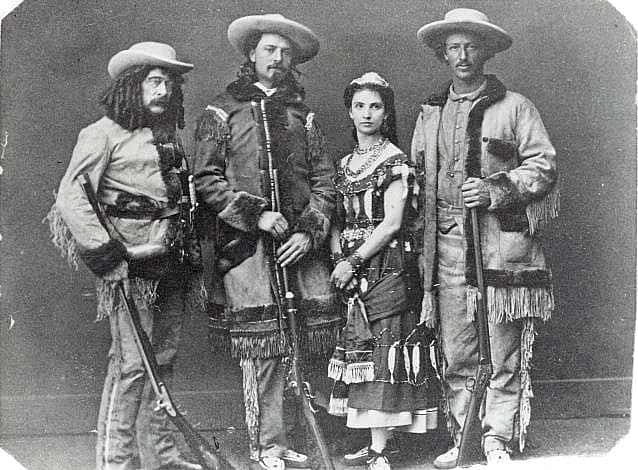
Scouts of the Prairie received mixed reviews. While many critics, including a writer for the Buffalo Post, claimed that “the play itself does not amount to much and the plot is slight,” critics and audiences alike nevertheless agreed that the production was a “sensation” and a “great success.” The New York Times offered one of the most positive reviews claiming, “On the whole we have no hesitation in conscientiously affirming that to be appreciated, Scouts of the Prairie must of necessity be seen… and we think we can safely promise whoever assists at its performances hearty enjoyment of a nature measured in the various instances by their own peculiar tastes and culture” further insisting that “Mlle. Morlacchi does not fall short of expectation.”
Even though the show was not praised for the quality of its plot or its actors, it was a financial success, with one account reporting that there was not enough space in the theatre for the audience and that theater managers had to turn people away. The show toured around the country, making stops in major cities such as St. Louis, Cincinnati, Rochester, Buffalo, Boston, Philadelphia, Richmond, and New York City.
Enter Texas Jack, Romance, and Tragedy
In 1873, one year after the debut of Scouts of the Prairie, Giuseppina Morlacchi married John Omohundro, better known to audiences as “Texas Jack.” The couple purchased a home together in Lowell, Massachusetts, and Morlacchi balanced her ballet career with the demands of touring alongside her husband for theatrical engagements. In 1876, Texas Jack broke away from his partnership with Buffalo Bill Cody and formed his own touring theatrical company. Morlacchi joined him on these tours, and Texas Jack’s production company actually predated Buffalo Bill’s far more famous Wild West show.
Tragedy struck in 1880 when Texas Jack contracted pneumonia and died. Morlacchi retired from performing in order to care for her husband during his illness, and after his death she never returned to the stage. Interestingly, although she may have adopted the surname Omohundro after her marriage, newspapers continued to refer to her professionally as Morlacchi. Contemporary accounts also suggest that their Lowell home was purchased jointly rather than solely by Texas Jack.
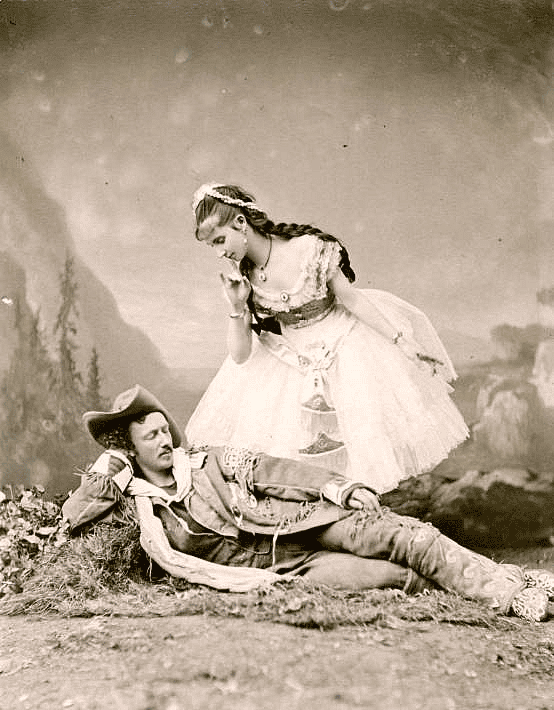
Although their marriage lasted only about seven years, it appears to have been unconventional by nineteenth-century standards. The couple had no children, and Morlacchi continued to pursue a professional career rather than withdrawing into the domestic sphere expected of many married women. Reports of her profound grief following Texas Jack’s death and her permanent retirement from the stage suggest a deep emotional bond between the two. This sense of partnership is also reflected in the staged photograph above. In this image, Omohundro reclines on the ground while Morlacchi stands over him. Although the photograph is clearly staged, its purpose is unknown, and it cannot serve as evidence of their private relationship; it presents Morlacchi as more than just a supporting character. She occupies a prominent position in the image, suggesting that audiences were meant to see her as an important performer in her own right. While it is impossible to know the true nature of their relationship, the available evidence suggests a partnership marked by mutual respect and a degree of equality unusual for the era.
While Morlacchi never returned to the stage after her husband’s death, she remained involved in dance and was reportedly known to teach the Lowell mill girls. In her later years, she lived on a farm estate that she owned in Billerica, Massachusetts, a reminder of the financial success she had achieved through her career. In 1886, just six years after Texas Jack’s death, Morlacchi developed cancer and died there. Newspapers covering her death emphasized her fame by invoking both her stage name, “Morlacchi the Peerless,” and her identity as “the Famous Italian Danseuse.”
Although her life ended tragically, Morlacchi left behind a remarkable legacy. Her contributions to dance and to the development of early Wild West entertainment deserve greater recognition. As a financially independent woman who earned the admiration of audiences across the United States, she was a pioneering figure in American ballet. While many histories credit George Balanchine with establishing ballet as a major American art form in the 1930s, Morlacchi’s career suggests a longer and more complex story. Decades before Balanchine’s arrival, Morlacchi and her all-female ballet company introduced ballet to audiences throughout the United States, helping popularize the art form and demonstrating that women could achieve professional success and public acclaim on their own terms. Though largely forgotten today, her career challenges traditional narratives about both the development of ballet in the United States and the opportunities available to women in the nineteenth century.
Bibliography
Baker, Barbara. “Morlacchi, Giuseppina,” February 2000. https://doi.org/10.1093/anb/9780198606697.article.1801884.
Buffalo Post. “Academy of Music- The Scouts of the Prairie.” January 28, 1873. https://www.newspapers.com/image/264665313/?match=1&terms=scouts%20of%20the%20prairie.
Kerns, Matthew. “The Peerless Morlacchi.” Dime Library, October 8, 2020. https://www.dimelibrary.com/post/the-peerless-morlacchi.
Kerns, Matthew. “The Scandalous Can-Can.” Substack.com. Matthew’s Substack, October 12, 2023. https://matthewkerns.substack.com/p/the-scandalous-can-can.
New York Daily Herald. “Amusements.” November 11, 1867. https://www.newspapers.com/image/843827161/?match=3&terms=the%20devils%20auction%20or%20the%20golden%20branch.
Nypl. “The Celebrated Cancan Dance Executed by M’lls Morlacchi and Baretta – NYPL Digital Collections,” 1868. https://digitalcollections.nypl.org/items/6faefd10-18c5-0131-7d65-58d385a7bbd0?canvasindex=0.
Philadelphia Times. “Morlacchi the Peerless: Death of the Famous Italian Danseuse with the Story of Her Romantic Career.” August 12, 1886. https://www.newspapers.com/image/349224209/?match=1&terms=morlacchi.
Rochester Daily Union and Advertiser. “The Can-Can.” February 1869, 1869. https://www.newspapers.com/image/1275014512/?match=5&terms=cancan.
The New York Times. “Amusements.” April 1, 1873. https://www.newspapers.com/image/20507916/?match=1.
The Springfield Daily Republican. “The Immoral Drama at Boston.” February 5, 1868. https://www.newspapers.com/image/1061658055/?match=18&terms=the%20immoral%20drama%20at%20boston.
Wild West Staff. “The Most Popular Dancer of Her Era, She Once Shared the Stage With Buffalo Bill.” HistoryNet, May 22, 2023. https://historynet.com/famous-dancer-of-the-west/.
Review of LibGuides: Lowell History: Texas Jack and the Peerless Morlacchi: The Peerless Morlacchi. springshare, 2026. https://libguides.uml.edu/texas_jack.
Review of “The Devil’s Auction.” | Ann Arbor District Library. Aadl.org, 2026. https://aadl.org/node/492088.
Written By
Caleigh Noonan
Caleigh Noonan is a recent graduate of the College of the Holy Cross in Worcester, Massachusetts. She is serving as the Indian Education for All Intern at the Buffalo Bill Center of the West for the summer. Her interests include Indigenous history, nineteenth- and twentieth-century American history, and the history of dance.
You May Also Like

Before the White Man Came: Examining Native Representation in Early American Film
Aug 20, 2026

Popular films and television shows like Dances with Wolves and...
The Ultimate Wyoming Wildlife Guide: Expert Viewing Tips
Sep 28, 2026

Grizzly Flowers. Photo by Julia Cook @julia.littlelightningnature Draper Elk Wyoming...
Your #AskAnArchivist Questions, Answered
Oct 14, 2026

There are few things an archivist enjoys more than a...
The Secret Custer Letter: Rediscovering Little Bighorn at 150
Jun 02, 2026
Earlier this year, while reprocessing the MS 89 Jack Richard...
Don’t Let History Live in a Shoebox: How to Archive Your Family Treasures
Sep 18, 2026
Are you the designated "historian" in your family? Do you...
Greasy Grass at 150: Art, Heroism, and the Tragedy at Little Bighorn
May 21, 2026

Lt. Colonel George Armstrong Custer stands just right of center,...
Eastern Chic and Western Mystique: New Yorkers and the Buffalo Bill Center of the West
Jun 23, 2026

"The Buffalo Bill Center is the best Western museum that...
Rare Book Highlights: The Original Journals of the Lewis and Clark Expedition
Oct 01, 2026
"If not for the … epic the captains scratched out...
The Life Style of Yellow-bellied Sapsuckers
Sep 16, 2026

Tree girdled with Yellow-bellied Sapsucker Holes © Dennis Donohue /...
From Buffalo Bill to Balanchine: The Rise of Ballet Americana
Jul 02, 2026
After thirty years of sensationalized touring performances, Buffalo Bill's Wild...