Home » The Secret Custer Letter: Rediscovering Little Bighorn at 150 

The Secret Custer Letter: Rediscovering Little Bighorn at 150 

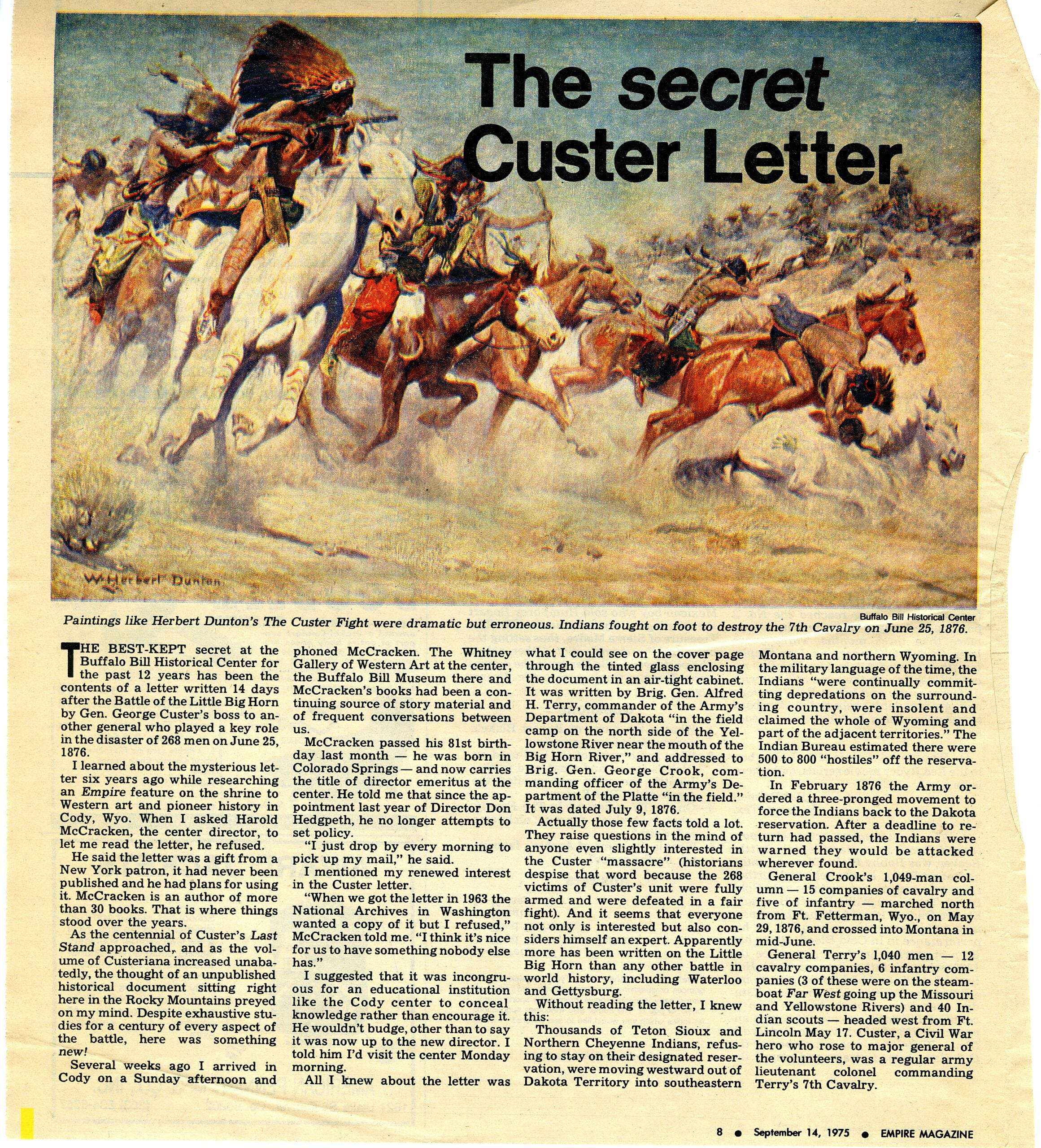
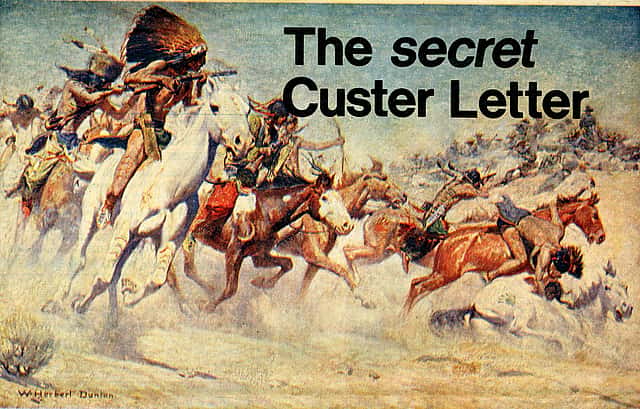
Earlier this year, while reprocessing the MS 89 Jack Richard Collection, our Archives Assistant stumbled upon a September 14, 1975, article by Zeke Scher published in Empire Magazine, an insert of the Denver Post. The article’s title immediately caught her attention: “THE SECRET CUSTER LETTER.”

2026 is a landmark year for anniversaries. Alongside the United States’ semiquincentennial, the year also marks the sesquicentennial, or 150th anniversary, of the Battle of the Little Bighorn, also known as the Battle of the Greasy Grass or Custer’s Last Stand. The discovery of an article discussing a “secret” letter connected to George Armstrong Custer and the conflict could not have come at a better time. 

The article traces Scher’s efforts to gain access to a “secret” letter reportedly held in a locked display case at the then Buffalo Bill Historical Center. According to the article, the letter was an original document unknown to other Custer scholars. After finally gaining access to it, Scher emphasized the rarity of the correspondence, claiming that even the National Archives did not possess an official copy. 

September 14, 1975 Empire Magazine article, MS 89 Jack Richard Collection, MS89.15.17.04
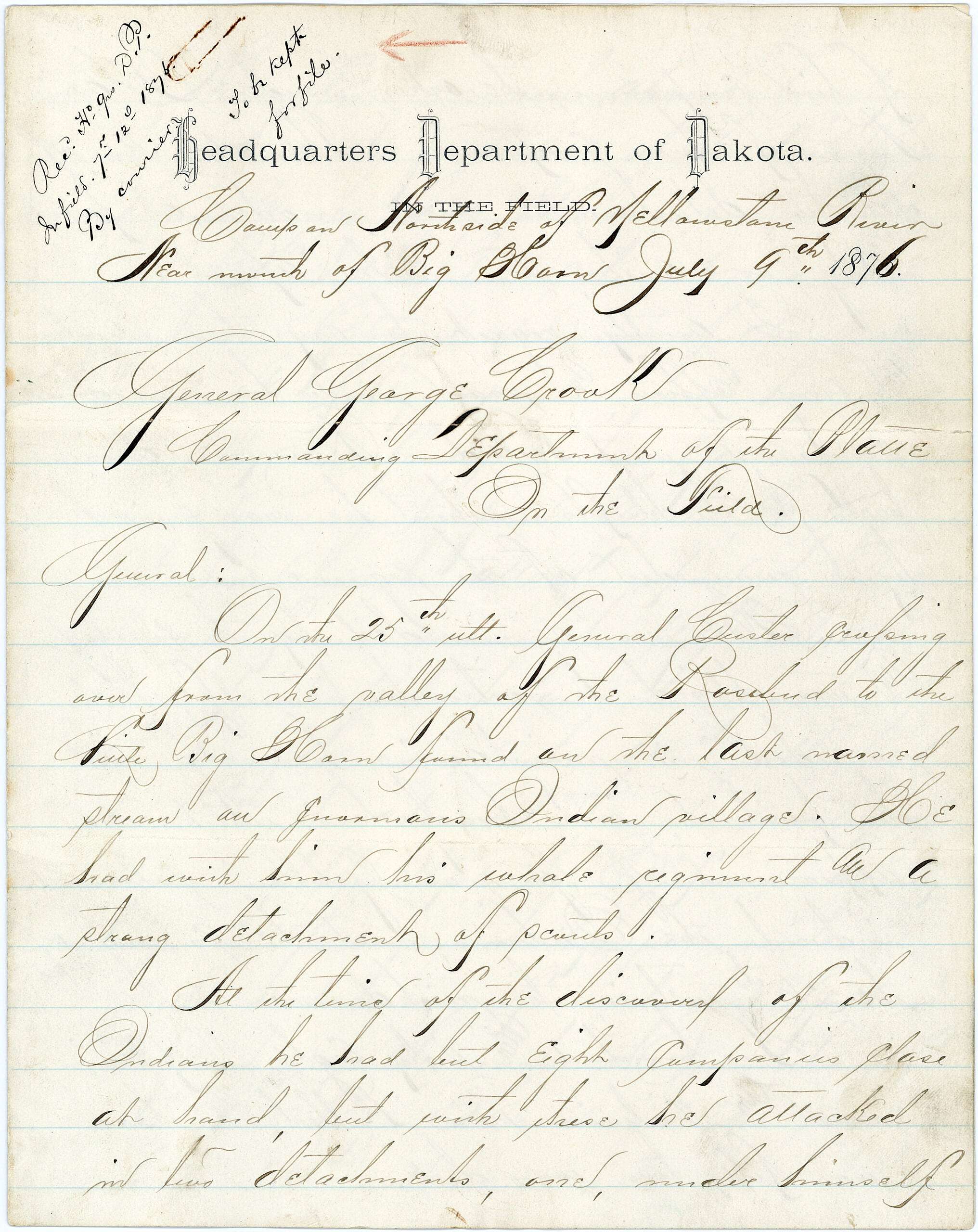
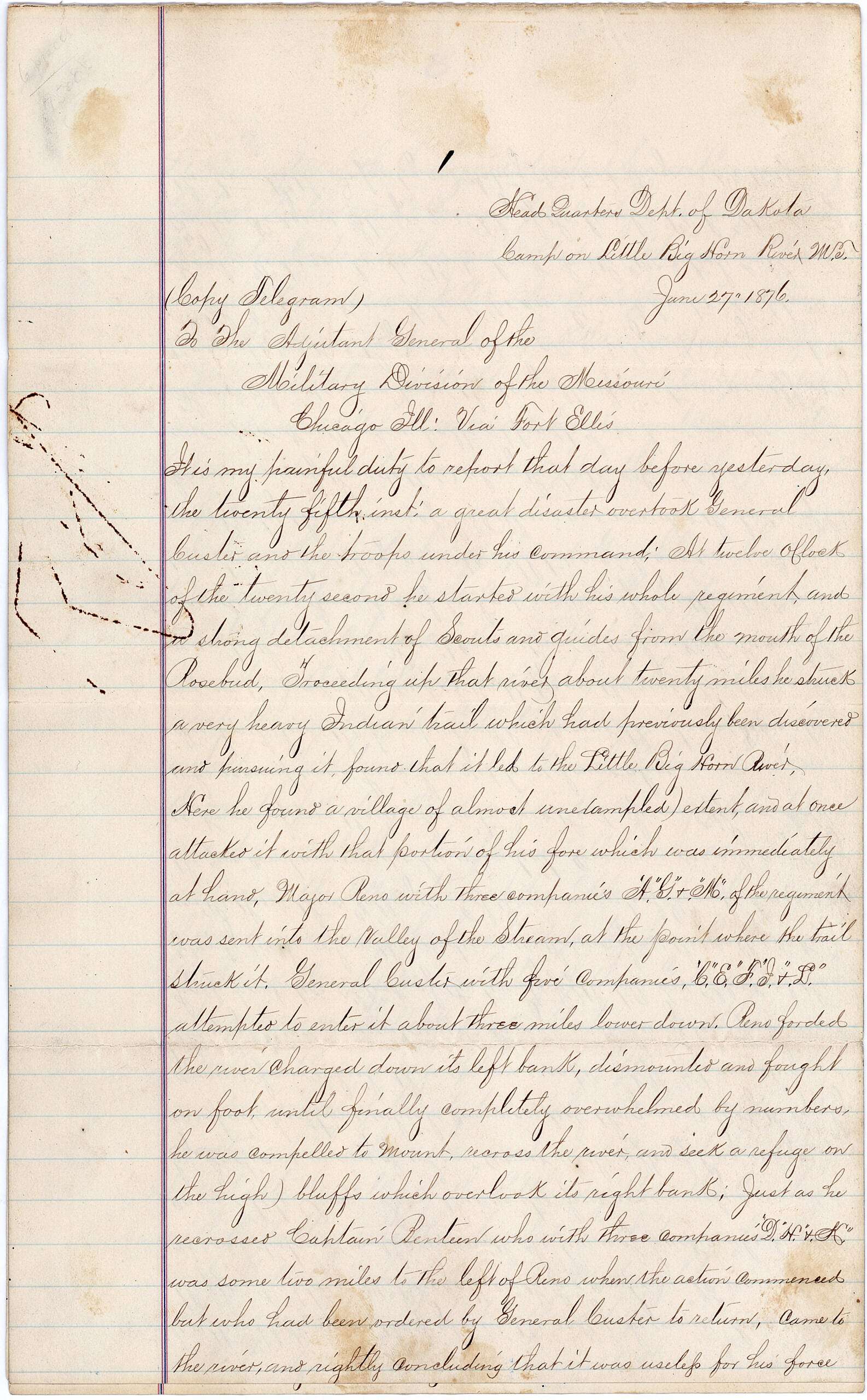
General Terry's second report to General George Crook on the Battle of the Little Bighorn, MS 007 George Armstrong Custer Collection, MS7.1.2.01.01

None of us in the archives had ever heard of a so-called “secret” Custer letter, so we reached out to Sam Hanna, Curatorial Assistant of the Buffalo Bill Museum, to see if he knew anything about it. Hanna had never heard of the letter either, and had no idea the Center supposedly held the original copy. If the article itself sparked our curiosity, Hanna’s surprise pushed us straight into investigation mode. It was time to dig into our collections and find this letter. 

The best place to begin searching the McCracken’s archival collections is through our online databases: ArchivesSpace and ContentDM. ArchivesSpace provides detailed descriptions of archival collections, while ContentDM offers access to digitized archival materials available to view online. 

I began our correspondence hunt with keyword searches in ArchivesSpace. Though the letter was not cataloged in our database as a “secret letter,” keyword searches for “Custer” and “General Terry” quickly narrowed the field. Among the results was a piece of correspondence housed within the MS 007 George Armstrong Custer Collection: a letter dated July 9, 1876 from General Alfred Terry to General George Crook.  A review of the corresponding digital scan confirmed it – we found the “secret” letter.  

Unlike when Scher encountered the document locked away in a display case, the letter now resides alongside other original correspondence related to the Battle of the Little Bighorn within the archives. The letter now exists as part of a much larger historical conversation within the MS 007 collection, rather than preserved as an isolated historical curiosity. 

The MS 007 George Armstrong Custer Collection preserves a remarkable group of original correspondence and firsthand accounts related to the Battle of the Little Bighorn and its aftermath. Among its most significant documents are two original reports from General Alfred Terry to General George Crook, including the so-called “secret” letter, as well as some of the earliest official reports describing Custer’s defeat in battle.

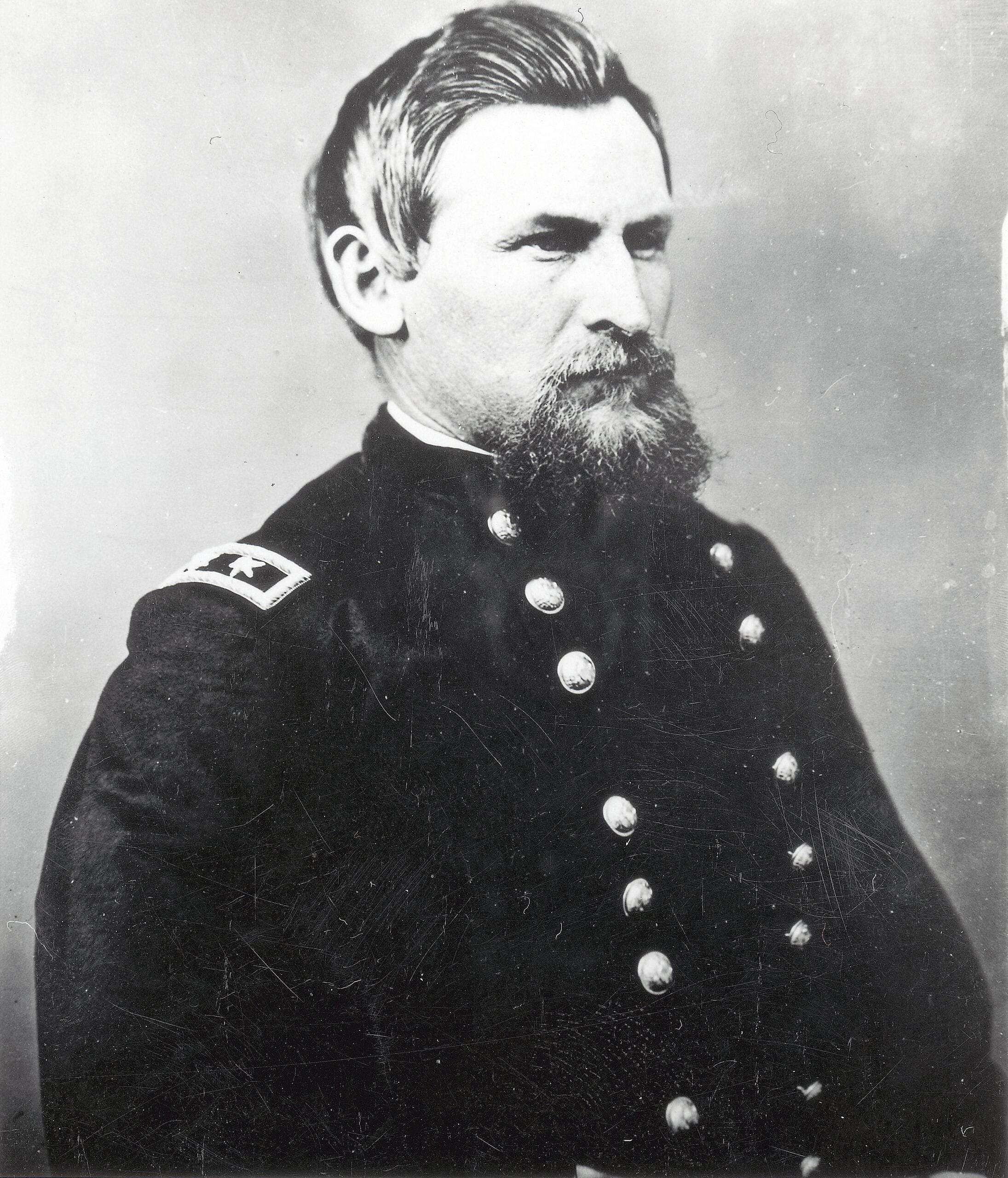
General George Crook, MS 71 Vincent Mercaldo Collection, P.71.217
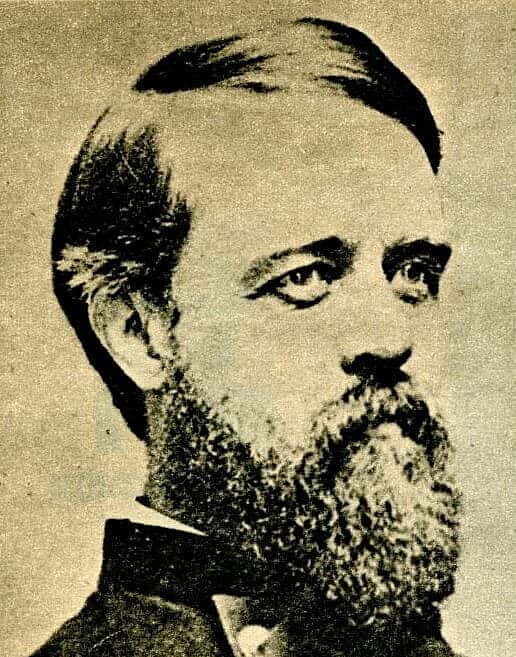
General Alfred H. Terry, MS 89 Jack Richard Collection, MS89.15.17.06

The collection also includes later reflections and correspondence that reveal how the battle continued to shape memory and interpretation in the years that followed. Among these are reminiscences by Wilmont Sanford concerning the battle and a letter from General Edward Settle Godfrey to Edgar Samuel Paxson discussing the conflict. Notably, General Godfrey’s letter was sent in January 1896, nearly 20 years after the battle, and potentially assisted Paxon in the creation of his 1899 painting “Custer’s Last Stand.” 

The discovery of General Terry’s reports within the collection provided an opportunity to compare his evolving account of the battle and its aftermath. Read side by side, the reports reveal notable differences in tone, detail, and even casualty figures. 

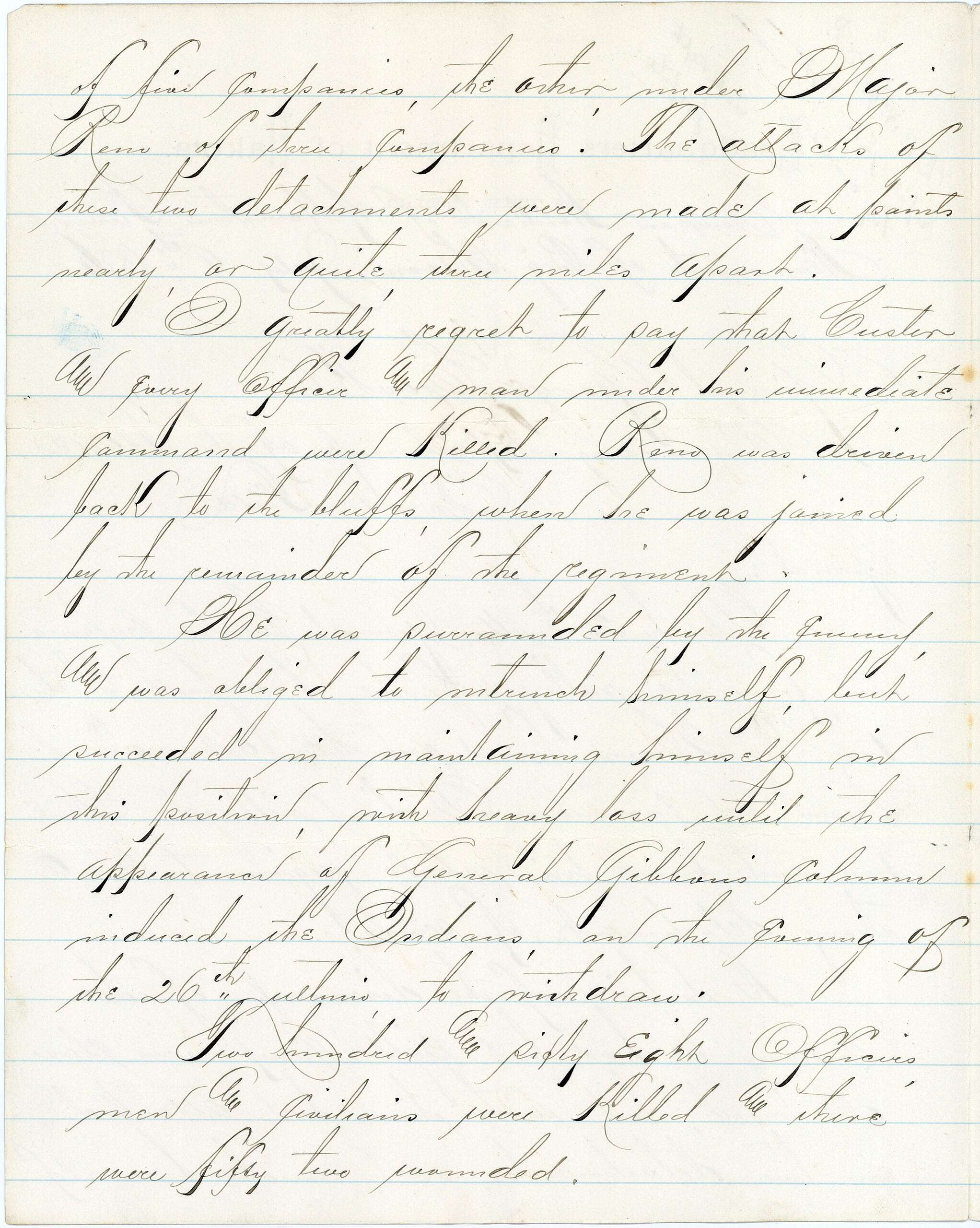
In his June 27 report, Terry estimated that 250 officers and enlisted men had been killed, with 51 wounded. By July 9, those figures had changed to 268 officers, men, and civilians killed and 52 wounded. The discrepancy is a reminder that Terry was writing in the immediate aftermath of the battle, when information was still being gathered and verified. 

The contrast in tone is equally striking. In the July 9 report, Terry states the outcome plainly: “I greatly regret to say that Custer and every officer and man under his immediate command were killed.” The June 27 report approaches the defeat more indirectly, opening instead with the statement that “a great disaster overtook General Custer and the troops under his command.” While both reports convey the same devastating news, the later account appears more direct and detached, perhaps reflecting the passage of time and the gradual replacement of uncertainty with confirmed information.

General Terry's first telegram to the General George Crook after the Battle of the Little Bighorn, MS 007 George Armstrong Custer Collection, MS7.1.1.01.01
General Terry's second report to General George Crook on the Battle of the Little Bighorn, MS 007 George Armstrong Custer Collection, MS7.1.2.01.02

Comparing the reports also reveals how Terry’s priorities shifted in the days following the battle. The June 27 report provides a detailed, almost chronological account of troop movements and events leading up to and immediately following the engagement. The July 9 report is far more concise, summarizing the actions of Custer and Reno before turning to practical concerns such as evacuating the wounded, communicating with military leadership, and securing supplies. Together, the reports capture a transition from immediate reaction to administrative response, illustrating how military leaders documented and managed the aftermath of one of the most consequential battles of the American West. 

While this blog highlights only a few differences between the reports, the full documents offer additional insights into how General Terry understood and communicated the aftermath of the Battle of the Little Bighorn. Digital scans of both reports are available online: June 26, 1876 – First Report and July 9, 1876 – Second Report.

Our search began with a newspaper article about a “secret” letter and a simple question: did the letter still exist in our collections? The answer, of course, was yes. But in the process of finding it, we were reminded that the true strength of archival collections lies not in a single remarkable document, but in the connections between records. Read together, the reports, letters, and reminiscences preserved within the MS 007 George Armstrong Custer Collection provide a more complete picture of the Battle of the Little Bighorn and its aftermath than any one document could alone. As we approach the battle’s 150th anniversary, these materials offer an opportunity to revisit familiar history through the voices of those who experienced, documented, and remembered it. 

McCracken Research Library

Written By

Cassandra Day avatar

Cassandra Day

Cassandra Day is the Archivist of the McCracken Research Library at the Buffalo Bill Center of the West, where she specializes in the preservation, interpretation, and accessibility of historical records. She holds a Bachelor of Arts in History from Georgia Southern University and a Master of Science in Archival Studies from Clayton State University. Additionally, she is a Certified Archivist through the Academy of Certified Archivists. Her research interests include World War II and Cold War codebreaking, oral history methodologies and best practices, and the exploration of regional identities through rodeo. She is passionate about making archival materials accessible and engaging while preserving the voices and stories that shape our understanding of the past.

You May Also Like